Cascina Vigna Park · tree 11 of 23
Small-leaved lime
Tilia cordata
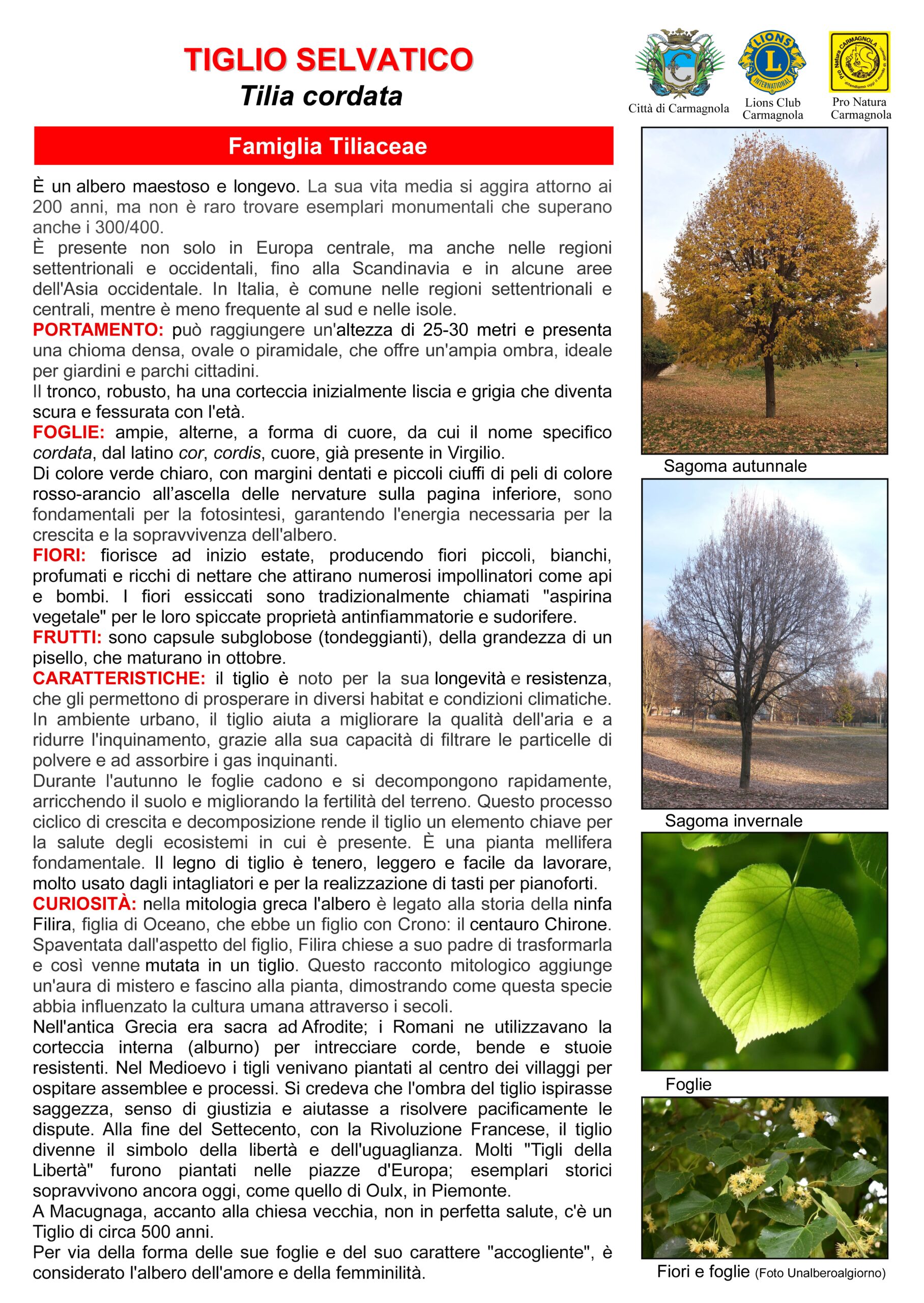
It is a majestic, long-lived tree. Its average lifespan is around 200 years, but it is not unusual to find monumental specimens that exceed even 300 or 400. It is found not only in central Europe but also in the northern and western regions, as far as Scandinavia, and in some parts of western Asia. In Italy it is common in the northern and central regions, while it is less frequent in the south and on the islands.
For children, and not only for them… (video in Italian)
Tree sheet
- Habit
It can reach a height of 25–30 metres and has a dense, oval or pyramidal crown that casts ample shade, ideal for gardens and city parks. The stout trunk has bark that is smooth and grey at first and becomes dark and fissured with age.
- Leaves
Broad, alternate and heart-shaped, hence the specific name cordata, from the Latin cor, cordis, heart, already found in Virgil. Light green, with toothed margins and small tufts of orange-red hairs in the axils of the veins on the lower surface, they are essential for photosynthesis, providing the energy the tree needs to grow and survive.
- Flowers
It flowers in early summer, producing small, white, scented flowers rich in nectar, which attract many pollinators such as bees and bumblebees. The dried flowers are traditionally called "plant aspirin" for their marked anti-inflammatory and sweat-inducing properties.
- Fruits
They are subglobose (roundish) capsules, the size of a pea, which ripen in October.
- Features
The lime is known for its longevity and hardiness, which allow it to thrive in a variety of habitats and climatic conditions. In towns and cities the lime helps to improve air quality and to reduce pollution, thanks to its ability to filter dust particles and absorb polluting gases. In autumn the leaves fall and decompose quickly, enriching the soil and improving its fertility. This cyclical process of growth and decomposition makes the lime a key element in the health of the ecosystems in which it is found. It is a bee plant of fundamental importance. Lime wood is soft, light and easy to work, much used by woodcarvers and for making piano keys.
- Curiosities
In Greek mythology the tree is linked to the story of the nymph Philyra, daughter of Oceanus, who had a son by Cronus: the centaur Chiron. Frightened by her son's appearance, Philyra asked her father to transform her, and so she was changed into a lime tree. This myth adds an aura of mystery and fascination to the plant, showing how this species has influenced human culture down the centuries. In ancient Greece it was sacred to Aphrodite; the Romans used its inner bark (sapwood) to plait strong ropes, bandages and mats. In the Middle Ages limes were planted in the centre of villages as a place for assemblies and trials. The shade of the lime was believed to inspire wisdom and a sense of justice and to help settle disputes peacefully. At the end of the 18th century, with the French Revolution, the lime became the symbol of liberty and equality. Many "Liberty Limes" were planted in the squares of Europe; historic specimens still survive today, such as the one at Oulx, in Piedmont. At Macugnaga, beside the old church, there is a lime about 500 years old, not in perfect health. Because of the shape of its leaves and its "welcoming" character, it is regarded as the tree of love and femininity.
The original sheet (in Italian)
Show the illustrated sheet