Cascina Vigna Park · tree 03 of 23
Red oak
Quercus rubra
A non-native species, originally from the Rocky Mountains of North America, it was introduced into Europe in 1724 as an ornamental tree and for reforestation.
For children, and not only for them… (video in Italian)
Tree sheet
- Habit
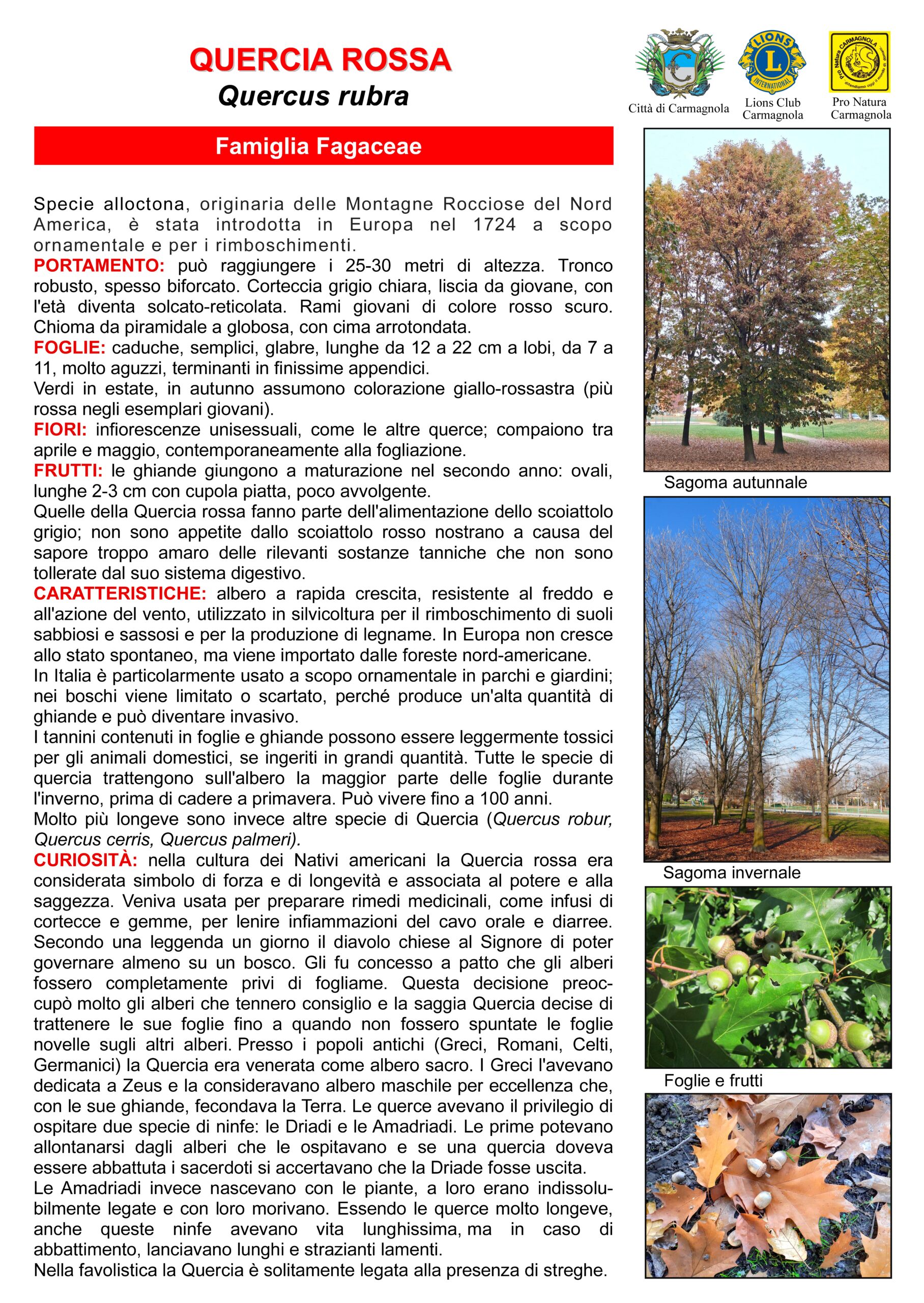
It can reach 25–30 metres in height. The trunk is stout and often forked. The bark is light grey and smooth when young, becoming furrowed in a net-like pattern with age. The young branches are dark red. The crown is pyramidal to globose, with a rounded top.
- Leaves
Deciduous, simple, glabrous, 12 to 22 cm long, with 7 to 11 very sharply pointed lobes ending in very fine bristle-like tips. Green in summer, in autumn they turn a reddish yellow (redder in young trees).
- Flowers
Unisexual inflorescences, as in the other oaks; they appear between April and May, at the same time as the leaves come out.
- Fruits
The acorns ripen in their second year: they are oval and 2–3 cm long, with a flat cup that encloses little of the acorn. Those of the red oak are part of the diet of the grey squirrel; our native red squirrel does not find them palatable, because of the excessively bitter taste of the large amount of tannins they contain, which its digestive system cannot tolerate.
- Features
A fast-growing tree, resistant to cold and to the action of the wind, used in forestry for the reforestation of sandy and stony soils and for timber production. In Europe it does not grow wild, but is imported from the forests of North America. In Italy it is used above all as an ornamental in parks and gardens; in woodland it is kept in check or discarded, because it produces a large quantity of acorns and can become invasive. The tannins contained in the leaves and acorns can be mildly toxic to domestic animals if eaten in large quantities. All species of oak keep most of their leaves on the tree through the winter, before they fall in spring. It can live for up to 100 years. Other species of oak, by contrast, are much longer-lived (Quercus robur, Quercus cerris, Quercus palmeri).
- Curiosities
In Native American culture the red oak was regarded as a symbol of strength and longevity and was associated with power and wisdom. It was used to prepare medicinal remedies, such as infusions of bark and buds, to soothe inflammation of the mouth and diarrhoea. According to a legend, one day the devil asked the Lord to be allowed to rule over at least one wood. This was granted on condition that the trees were completely bare of foliage. The decision greatly worried the trees, which held a council, and the wise Oak decided to keep its leaves until the new leaves had come out on the other trees. Among ancient peoples (Greeks, Romans, Celts, Germanic peoples) the oak was venerated as a sacred tree. The Greeks had dedicated it to Zeus and regarded it as the male tree par excellence, which fertilised the Earth with its acorns. Oaks had the privilege of being home to two kinds of nymph: the Dryads and the Hamadryads. The former could leave the trees that housed them, and if an oak had to be felled the priests made sure that the Dryad had come out. The Hamadryads, on the other hand, were born with the trees, were inseparably bound to them and died with them. As oaks are very long-lived, these nymphs too had a very long life, but if the tree was felled they let out long, heart-rending laments. In fairy tales the oak is usually linked to the presence of witches.
The original sheet (in Italian)
Show the illustrated sheet