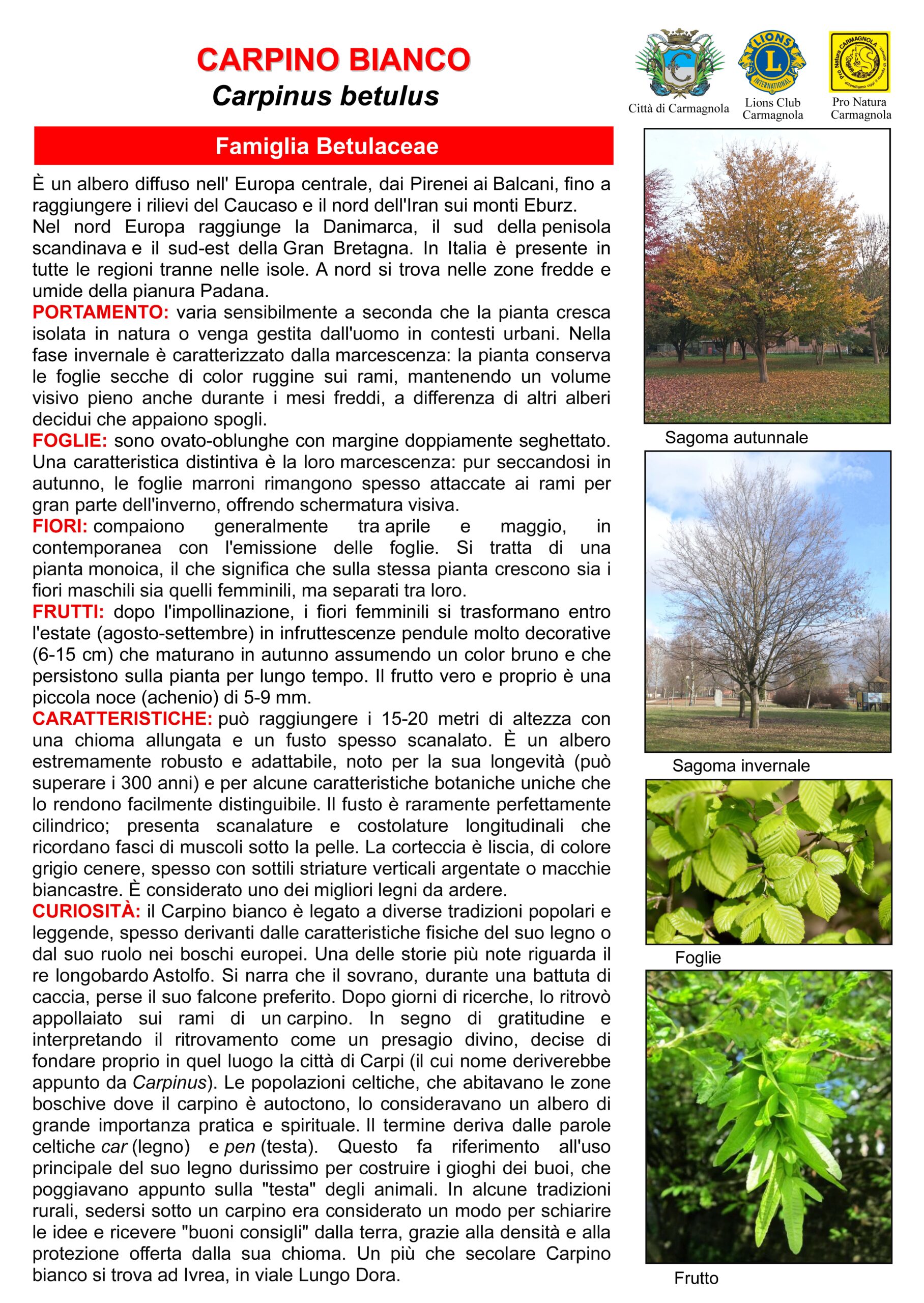
Cascina Vigna Park · tree 17 of 23
Common hornbeam
Carpinus betulus
It is a tree widespread in central Europe, from the Pyrenees to the Balkans, reaching as far as the Caucasus range and the north of Iran, in the Elburz mountains. In northern Europe it reaches Denmark, the south of the Scandinavian peninsula and the south-east of Great Britain. In Italy it is present in every region except the islands. In the north it is found in the cold, damp areas of the Po Valley.
For children, and not only for them… (video in Italian)
Tree sheet
- Habit
It varies considerably depending on whether the tree grows on its own in the wild or is managed by people in urban settings. In winter it is characterised by marcescence: the tree keeps its dry, rust-coloured leaves on the branches, retaining a full visual volume even during the cold months, unlike other deciduous trees, which look bare.
- Leaves
They are ovate-oblong with a doubly serrated margin. A distinctive feature is their marcescence: although they wither in autumn, the brown leaves often stay attached to the branches for much of the winter, providing a visual screen.
- Flowers
They generally appear between April and May, at the same time as the leaves emerge. It is a monoecious plant, which means that both male and female flowers grow on the same plant, but separately from each other.
- Fruits
After pollination, by summer (August–September) the female flowers turn into very decorative hanging infructescences (6–15 cm), which ripen in autumn, turning brown, and stay on the tree for a long time. The actual fruit is a small nut (achene) of 5–9 mm.
- Features
It can reach 15–20 metres in height, with an elongated crown and an often fluted trunk. It is an extremely hardy and adaptable tree, known for its longevity (it can live for more than 300 years) and for some unique botanical features that make it easy to recognise. The trunk is rarely perfectly cylindrical; it has lengthwise grooves and ribs that recall bundles of muscles under the skin. The bark is smooth and ash-grey, often with thin silvery vertical streaks or whitish patches. It is regarded as one of the best firewoods.
- Curiosities
The common hornbeam is linked to various folk traditions and legends, often arising from the physical properties of its wood or from its role in the woods of Europe. One of the best-known stories concerns the Lombard king Aistulf (Astolfo). It is said that the king, during a hunt, lost his favourite falcon. After days of searching, he found it perched on the branches of a hornbeam. As a sign of gratitude, and taking the discovery as a divine omen, he decided to found the town of Carpi on that very spot (its name is said to derive from Carpinus). The Celtic peoples, who lived in the wooded areas where the hornbeam is native, regarded it as a tree of great practical and spiritual importance. The name derives from the Celtic words car (wood) and pen (head). This refers to the main use of its very hard wood, for making ox yokes, which rested on the animals' "heads". In some rural traditions, sitting under a hornbeam was considered a way to clear one's mind and receive "good advice" from the earth, thanks to the density and protection offered by its crown. A common hornbeam well over a hundred years old stands in Ivrea, in viale Lungo Dora.
The original sheet (in Italian)
Show the illustrated sheet