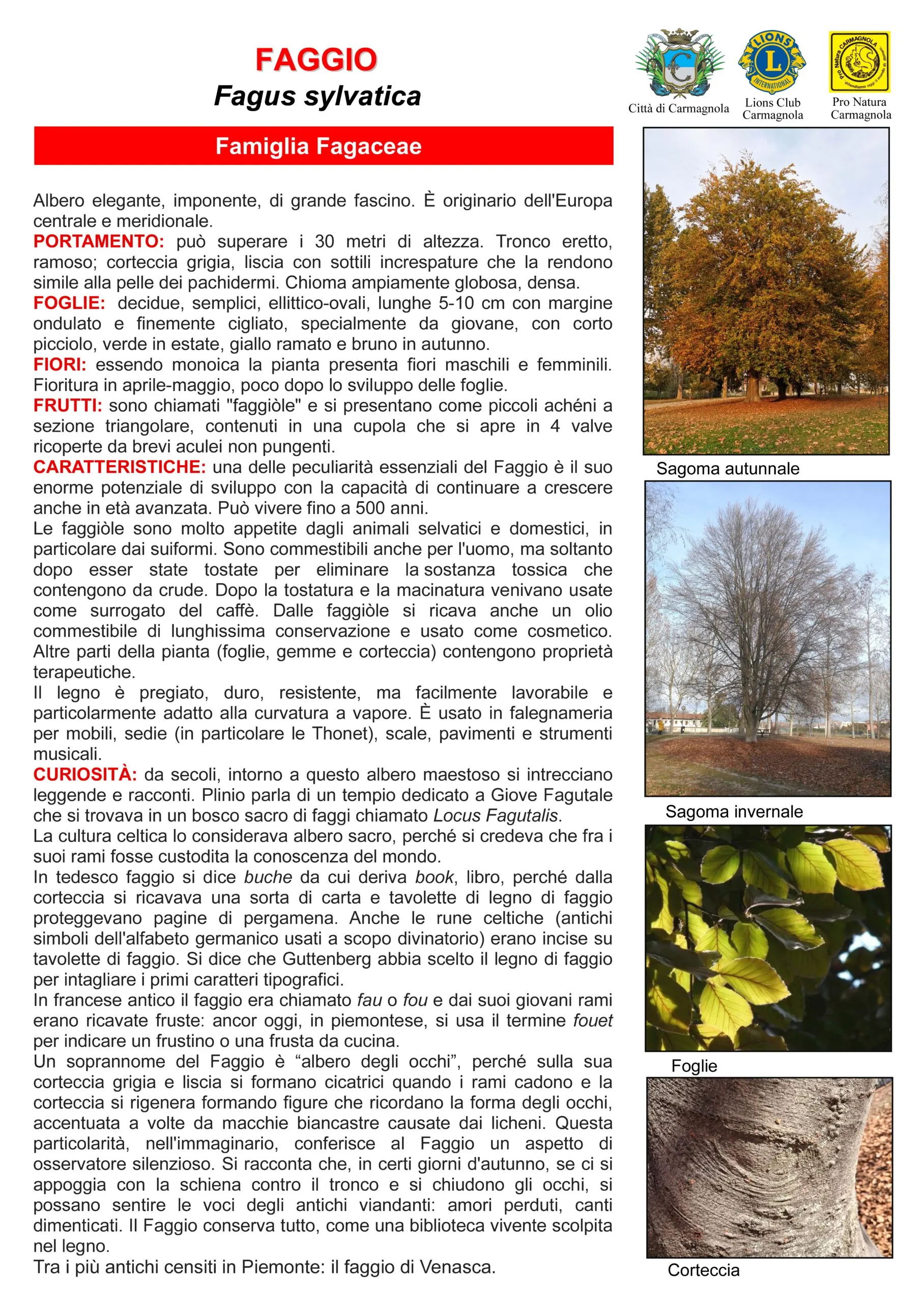
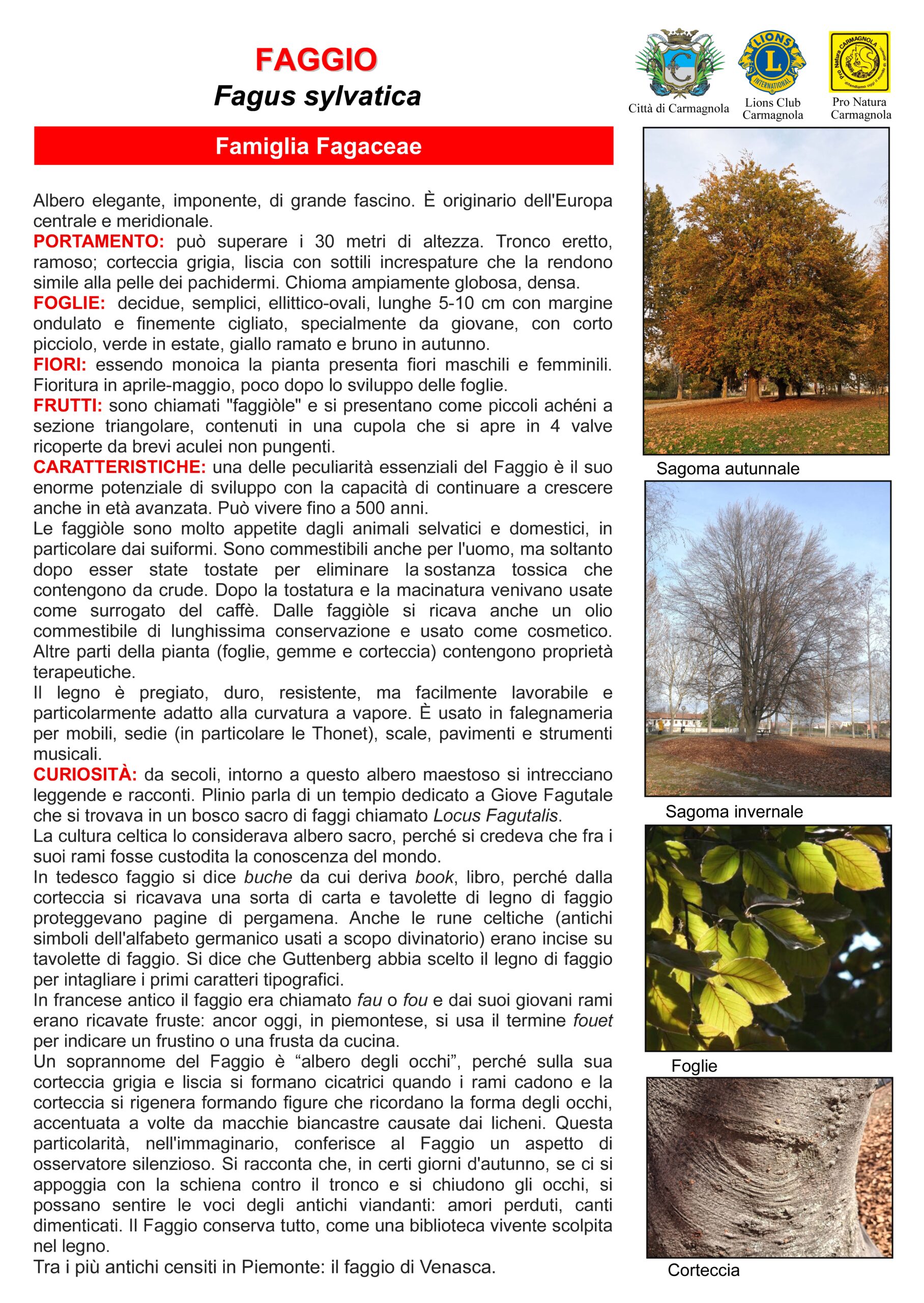
Cascina Vigna Park · tree 08 of 23
Common beech
Fagus sylvatica
An elegant, imposing tree of great charm. It is native to central and southern Europe.
For children, and not only for them… (video in Italian)
Tree sheet
- Habit
It can exceed 30 metres in height. Trunk upright and branching; bark grey and smooth, with fine wrinkles that make it look like the skin of pachyderms. Crown broadly rounded and dense.
- Leaves
Deciduous, simple, elliptic-oval, 5–10 cm long, with a wavy margin finely fringed with hairs, especially when young, and a short leaf stalk; green in summer, coppery yellow and brown in autumn.
- Flowers
Being monoecious, the plant has male and female flowers. It flowers in April–May, shortly after the leaves develop.
- Fruits
They are called beech nuts ("faggiòle" in Italian) and are small achenes, triangular in cross-section, held in a cupule that opens into 4 valves covered with short spines that do not prick.
- Features
One of the essential characteristics of the beech is its enormous potential for development, with the ability to keep growing even at an advanced age. It can live for up to 500 years.
Beech nuts are much sought after by wild and domestic animals, in particular by pigs and their relatives. They are also edible for humans, but only after being roasted to remove the toxic substance they contain when raw. Roasted and ground, they were used as a coffee substitute. Beech nuts also yield an edible oil that keeps for a very long time and is used as a cosmetic. Other parts of the plant (leaves, buds and bark) have therapeutic properties.
The wood is valuable, hard and strong, yet easy to work and particularly suited to steam bending. It is used in joinery for furniture, chairs (Thonet chairs in particular), stairs, floors and musical instruments.
- Curiosities
For centuries, legends and tales have been woven around this majestic tree. Pliny speaks of a temple dedicated to Jupiter Fagutalis that stood in a sacred beech wood called Locus Fagutalis.
Celtic culture regarded it as a sacred tree, because it was believed that the knowledge of the world was kept among its branches.
In German the beech is called Buche, from which book derives, because a kind of paper was obtained from the bark, and tablets of beech wood protected pages of parchment. Celtic runes too (ancient symbols of the Germanic alphabet used for divination) were carved on beech tablets. It is said that Gutenberg chose beech wood to carve the first printing type.
In Old French the beech was called fau or fou, and whips were made from its young branches: even today, in Piedmontese, the word fouet is used for a riding whip or a kitchen whisk.
One nickname of the beech is "tree of eyes", because scars form on its smooth grey bark when branches fall, and the bark regenerates, forming shapes that recall eyes, sometimes accentuated by whitish patches caused by lichens. In the imagination, this peculiarity gives the beech the look of a silent observer. It is said that, on certain autumn days, if you lean your back against the trunk and close your eyes, you can hear the voices of the wayfarers of old: lost loves, forgotten songs. The beech keeps everything, like a living library carved in wood.
Among the oldest recorded in Piedmont: the beech of Venasca.
The original sheet (in Italian)
Show the illustrated sheet