Cascina Vigna Park · tree 07 of 23
Tulip tree
Liriodendron tulipifera
It is native to the east coast of the North American continent and is also known as tulipier (from the French), Italianised as tulipifero. It takes its name from its flowers, which look like green-yellow tulips. The name of the genus derives from the Greek léirion, lily, and déndron, tree: lily tree. The specific epithet comes from tulipa, tulip, and fero, I bear: tulip-bearing, from the shape of the flowers, which recall tulips.
For children, and not only for them… (video in Italian)
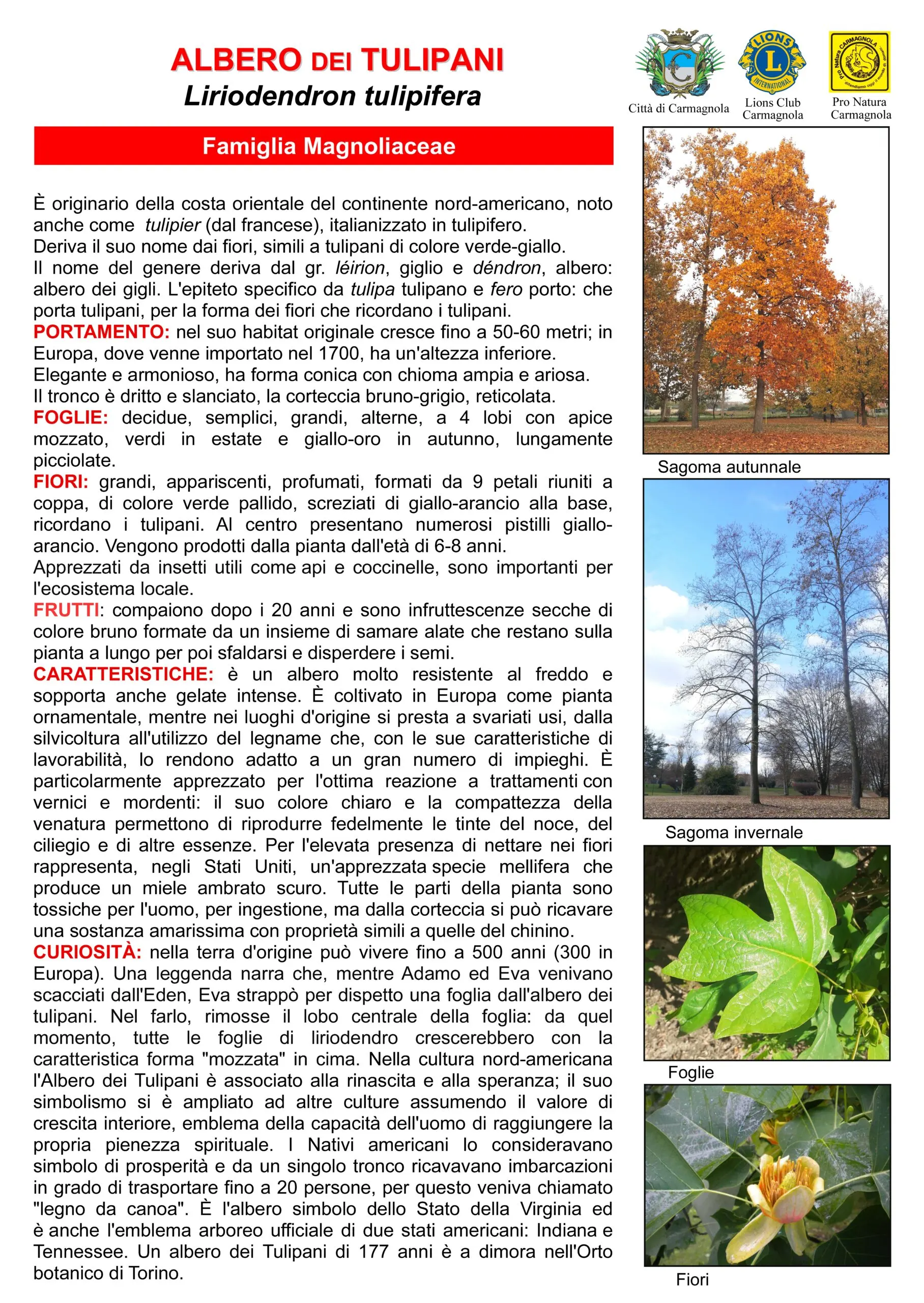
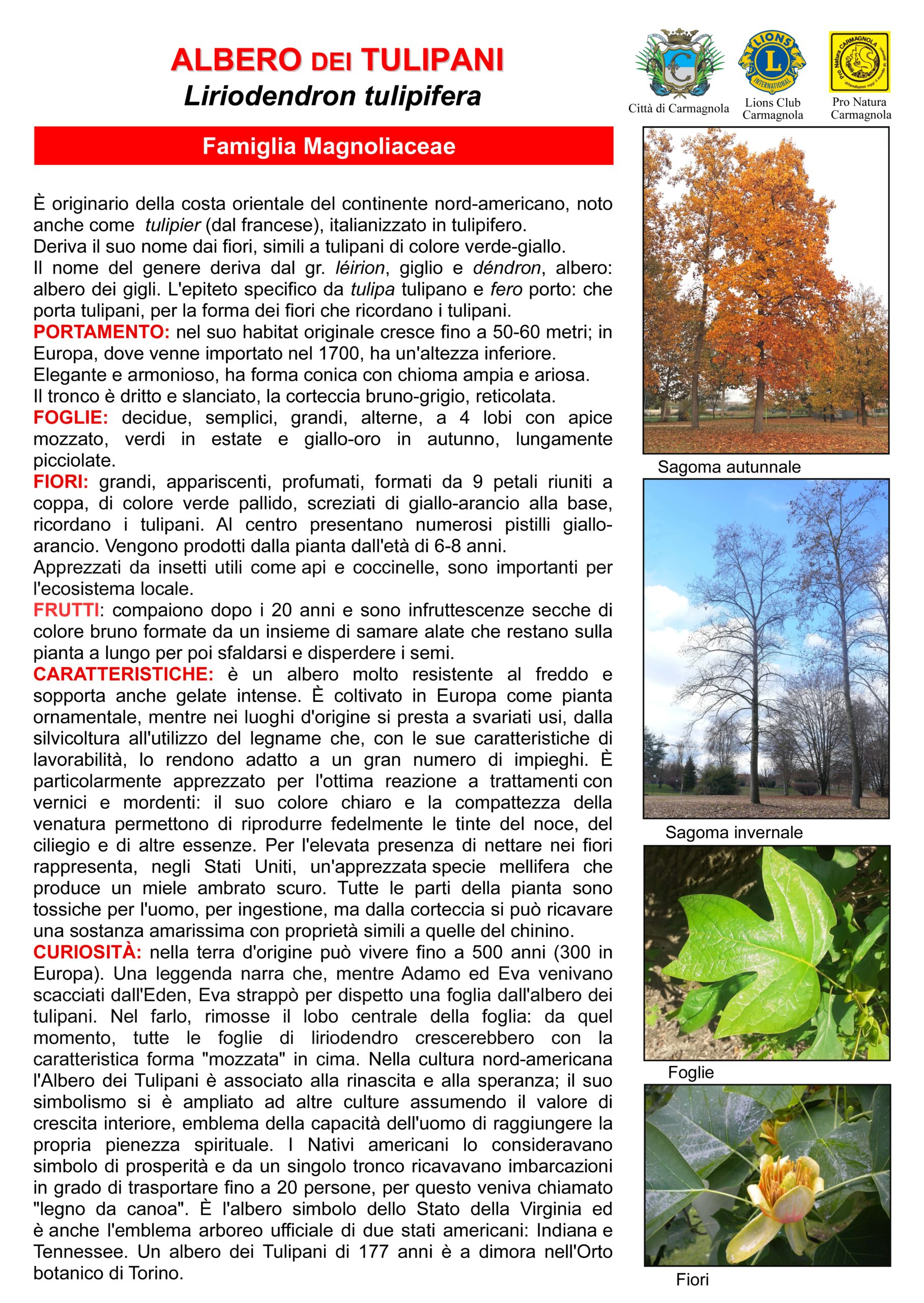
Tree sheet
- Habit
In its original habitat it grows to 50–60 metres; in Europe, where it was introduced in the 1700s, it is shorter. Elegant and well-proportioned, it has a conical shape with a broad, airy crown. The trunk is straight and slender, the bark grey-brown with a net-like pattern.
- Leaves
Deciduous, simple, large, alternate, with 4 lobes and a truncated tip, green in summer and golden yellow in autumn, on long leaf stalks.
- Flowers
Large, showy and scented, made up of 9 petals arranged in a cup, pale green, streaked with yellow-orange at the base; they resemble tulips. At the centre they have numerous yellow-orange pistils. The tree produces them from the age of 6–8 years. Popular with beneficial insects such as bees and ladybirds, they are important for the local ecosystem.
- Fruits
They appear after 20 years and are dry, brown fruiting heads made up of a cluster of winged samaras, which stay on the tree for a long time and then break up and scatter the seeds.
- Features
It is a very cold-hardy tree and also withstands hard frosts. It is grown in Europe as an ornamental plant, while in its native range it lends itself to a variety of uses, from forestry to the use of its timber, whose working properties make it suitable for a great many purposes. It is particularly valued for the way it takes varnishes and stains: its pale colour and close grain make it possible to reproduce faithfully the shades of walnut, cherry and other woods. Because of the abundant nectar in its flowers it is, in the United States, a valued bee plant that yields a dark amber honey. All parts of the plant are toxic to humans if ingested, but the bark yields an extremely bitter substance with properties similar to those of quinine.
- Curiosities
In its native land it can live for up to 500 years (300 in Europe). A legend tells that, as Adam and Eve were being driven out of Eden, Eve tore a leaf from the tulip tree out of spite. In doing so she removed the central lobe of the leaf: from that moment on, all the leaves of the tulip tree are said to grow with their characteristic shape, "cut off" at the top. In North American culture the tulip tree is associated with rebirth and hope; its symbolism has spread to other cultures, taking on the meaning of inner growth, an emblem of the human capacity to reach spiritual fulfilment. Native Americans regarded it as a symbol of prosperity, and from a single trunk they made boats able to carry up to 20 people, which is why it was called "canoe wood". It is the tree that symbolises the State of Virginia and is also the official state tree of two American states: Indiana and Tennessee. A 177-year-old tulip tree grows in the Botanical Garden of Turin.
The original sheet (in Italian)
Show the illustrated sheet