Cascina Vigna Park · tree 15 of 23
Crape myrtle
Lagerstroemia indica
Native to South-East Asia, it is loved for its spectacular, long-lasting summer flowering, which colours gardens and terraces in vibrant shades from pink to purple and even white. It is also known as albero di san Bartolomeo ("St Bartholomew's tree"), because its flowering reaches its peak on 24 August.
For children, and not only for them… (video in Italian)
Tree sheet
- Habit
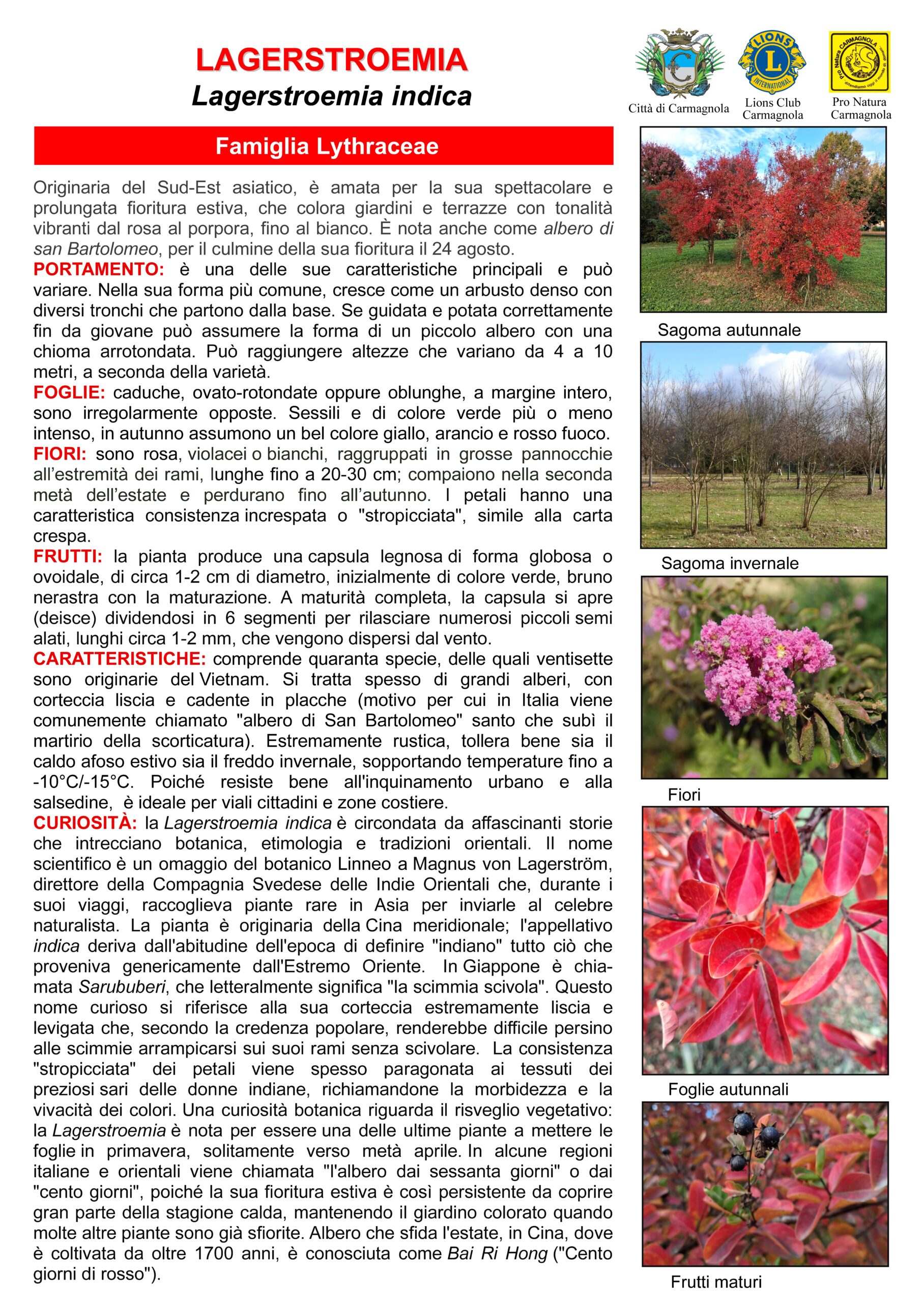
This is one of its main features, and it can vary. In its most common form it grows as a dense shrub with several trunks rising from the base. If trained and pruned correctly from an early age, it can take the form of a small tree with a rounded crown. It can reach heights ranging from 4 to 10 metres, depending on the variety.
- Leaves
Deciduous, rounded-ovate or oblong, with an entire margin, and irregularly opposite. Sessile and of a more or less deep green, in autumn they turn a fine yellow, orange and fiery red.
- Flowers
They are pink, purplish or white, grouped in large panicles at the ends of the branches, up to 20–30 cm long; they appear in the second half of summer and last until autumn. The petals have a characteristic crinkled or "crumpled" texture, similar to crêpe paper.
- Fruits
The plant produces a woody capsule, globose or ovoid in shape and about 1–2 cm in diameter, green at first and turning blackish brown as it ripens. When fully ripe, the capsule opens (dehisces), splitting into 6 segments to release many small winged seeds, about 1–2 mm long, which are dispersed by the wind.
- Features
The genus comprises forty species, twenty-seven of which are native to Vietnam. These are often large trees, with smooth bark that comes away in plates (which is why in Italy it is commonly called "St Bartholomew's tree", after the saint who was martyred by being flayed). Extremely hardy, it tolerates both sultry summer heat and winter cold well, withstanding temperatures down to −10 °C/−15 °C. As it stands up well to urban pollution and to salt-laden air, it is ideal for city avenues and coastal areas.
- Curiosities
Lagerstroemia indica is surrounded by fascinating stories that weave together botany, etymology and Eastern traditions. The scientific name is a tribute paid by the botanist Linnaeus to Magnus von Lagerström, director of the Swedish East India Company, who during his travels collected rare plants in Asia to send to the celebrated naturalist. The plant is native to southern China; the epithet indica comes from the habit, at the time, of calling "Indian" anything that came from the Far East in general. In Japan it is called Sarububeri, which literally means "the monkey slips". This curious name refers to its extremely smooth, polished bark which, according to popular belief, would make it hard even for monkeys to climb its branches without slipping. The "crumpled" texture of the petals is often compared to the fabrics of the precious saris worn by Indian women, recalling their softness and their bright colours. One botanical curiosity concerns the start of growth in spring: Lagerstroemia is known for being one of the last plants to come into leaf in spring, usually around mid-April. In some Italian and Eastern regions it is called "the sixty-day tree" or the "hundred-day" tree, because its summer flowering lasts so long that it covers most of the warm season, keeping the garden in colour when many other plants have already finished flowering. A tree that defies the summer, in China, where it has been grown for over 1,700 years, it is known as Bai Ri Hong ("A hundred days of red").
The original sheet (in Italian)
Show the illustrated sheet