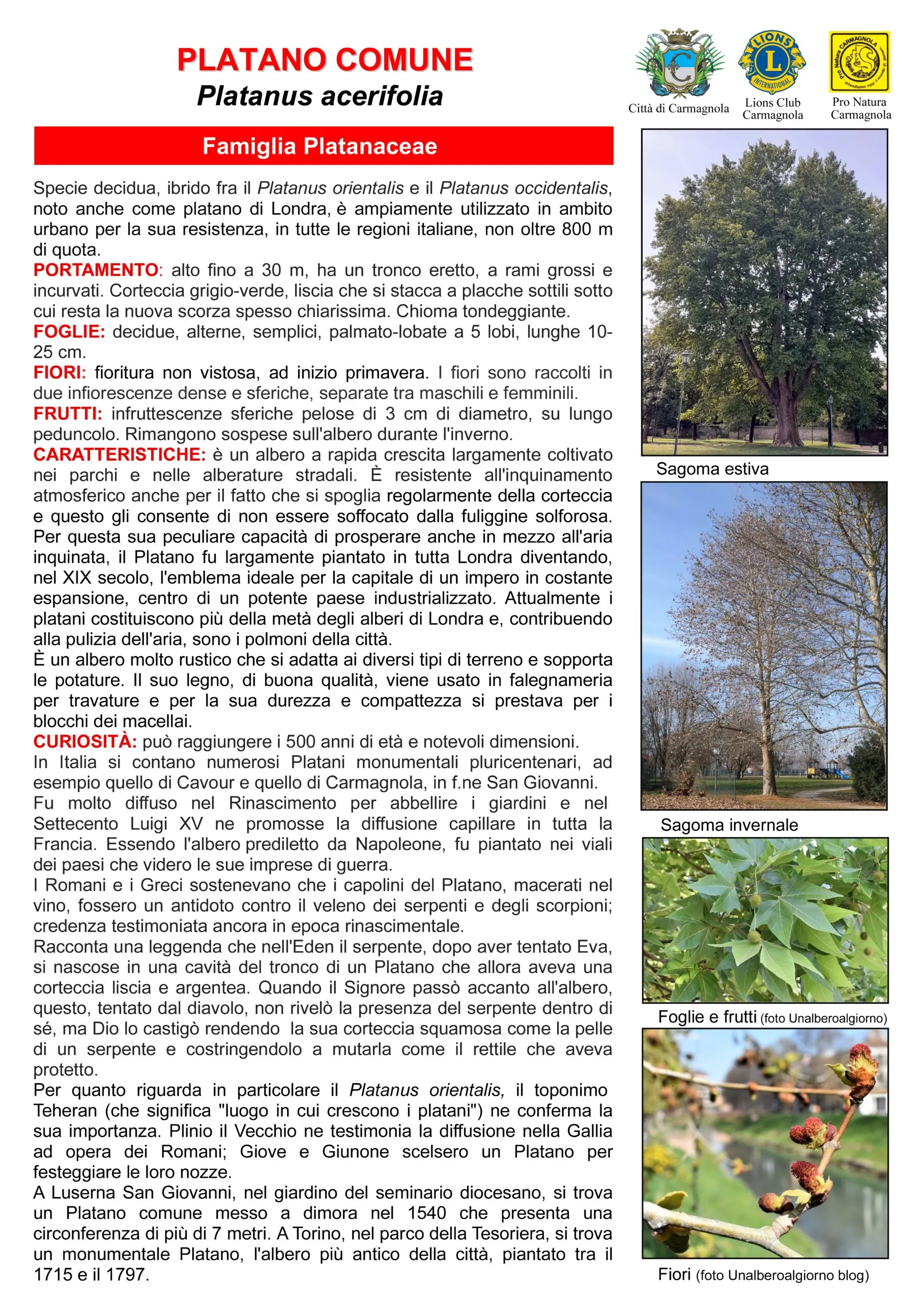
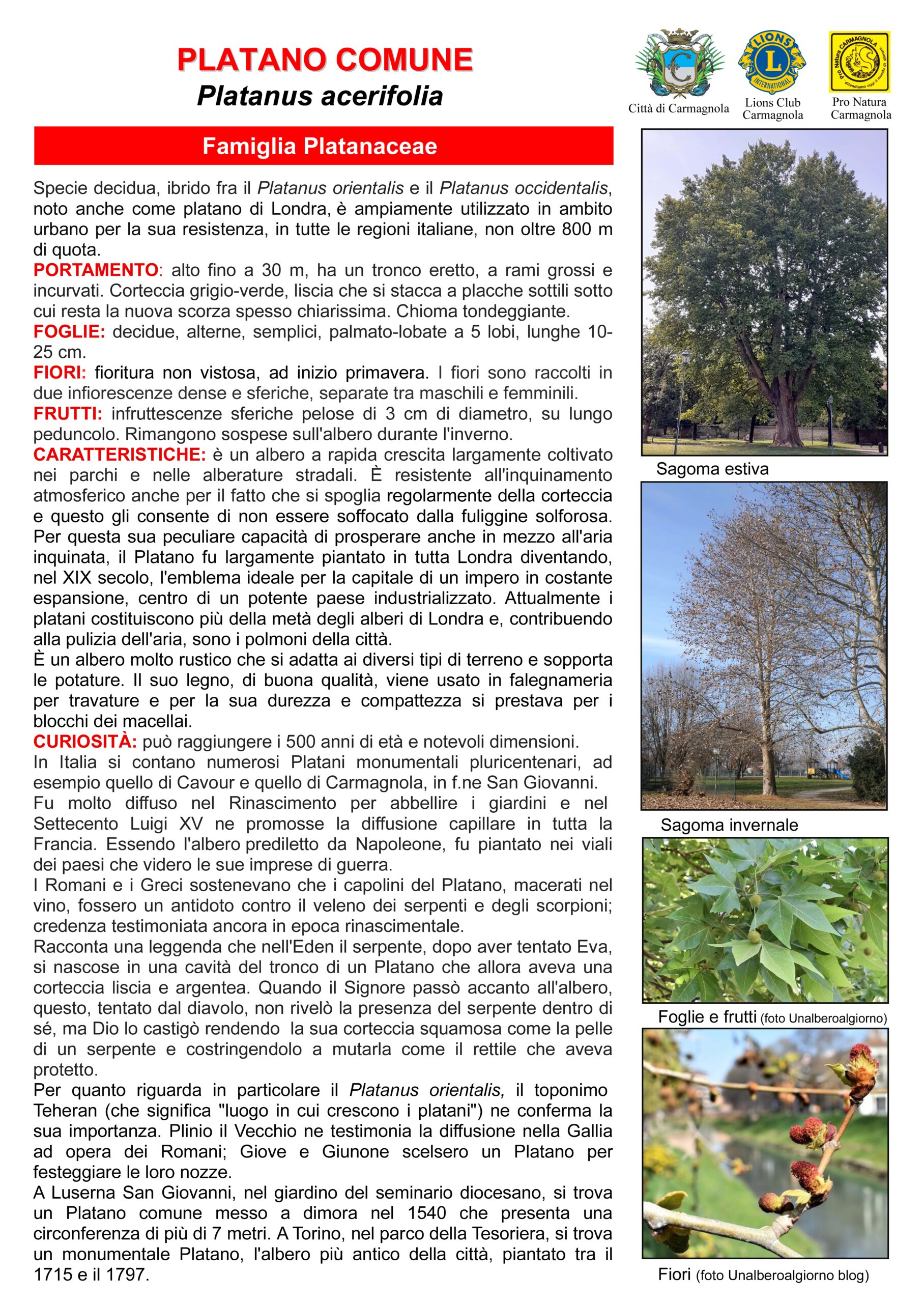
Cascina Vigna Park · tree 20 of 23
London plane
Platanus acerifolia
A deciduous species, a hybrid between Platanus orientalis and Platanus occidentalis, known in Italy as the platano comune ("common plane") and also as the platano di Londra ("London plane"), it is widely used in towns and cities for its hardiness, in all the regions of Italy, up to an altitude of no more than 800 m.
For children, and not only for them… (video in Italian)
Tree sheet
- Habit
Up to 30 m tall, it has an upright trunk with thick, curving branches. The bark is grey-green and smooth, and comes away in thin plates, leaving the new bark beneath, which is often very pale. The crown is roundish.
- Leaves
Deciduous, alternate, simple, palmately lobed with 5 lobes, 10–25 cm long.
- Flowers
The flowering is inconspicuous, in early spring. The flowers are gathered in two dense, spherical inflorescences, male and female separate.
- Fruits
Hairy, spherical fruiting heads 3 cm in diameter, on a long stalk. They stay hanging on the tree through the winter.
- Features
It is a fast-growing tree, widely grown in parks and as a street tree. It is resistant to air pollution, partly because it regularly sheds its bark, which keeps it from being smothered by sulphurous soot. Because of this peculiar ability to thrive even in polluted air, the plane was widely planted all over London, becoming in the 19th century the ideal emblem for the capital of a constantly expanding empire, the centre of a powerful industrialised country. Today planes make up more than half of London's trees and, by helping to clean the air, they are the lungs of the city. It is a very hardy tree that adapts to different types of soil and tolerates pruning. Its timber, of good quality, is used in carpentry for beams, and its hardness and close texture made it suitable for butchers' blocks.
- Curiosities
It can reach 500 years of age and a considerable size. Italy has many monumental planes several centuries old, for example the one at Cavour and the one at Carmagnola, in the hamlet of San Giovanni. It was widely planted in the Renaissance to adorn gardens, and in the 18th century Louis XV promoted its spread throughout the whole of France. As it was Napoleon's favourite tree, it was planted along the avenues of the countries that saw his military campaigns. The Romans and the Greeks maintained that the flower heads of the plane, steeped in wine, were an antidote to the venom of snakes and scorpions, a belief still recorded in the Renaissance. A legend tells that in Eden the serpent, after tempting Eve, hid in a hollow in the trunk of a plane tree, which at that time had smooth, silvery bark. When the Lord passed by the tree, the tree, tempted by the devil, did not reveal that the serpent was inside it; but God punished it by making its bark scaly like a snake's skin and forcing it to shed it like the reptile it had protected. As for Platanus orientalis in particular, the place name Tehran (which means "place where plane trees grow") confirms its importance. Pliny the Elder records that it was spread through Gaul by the Romans; Jupiter and Juno chose a plane tree under which to celebrate their wedding. At Luserna San Giovanni, in the garden of the diocesan seminary, there is a London plane planted in 1540 with a circumference of more than 7 metres. In Turin, in the Parco della Tesoriera, there is a monumental plane, the oldest tree in the city, planted between 1715 and 1797.
The original sheet (in Italian)
Show the illustrated sheet