Cascina Vigna Park · tree 12 of 23
Norway maple
Acer platanoides
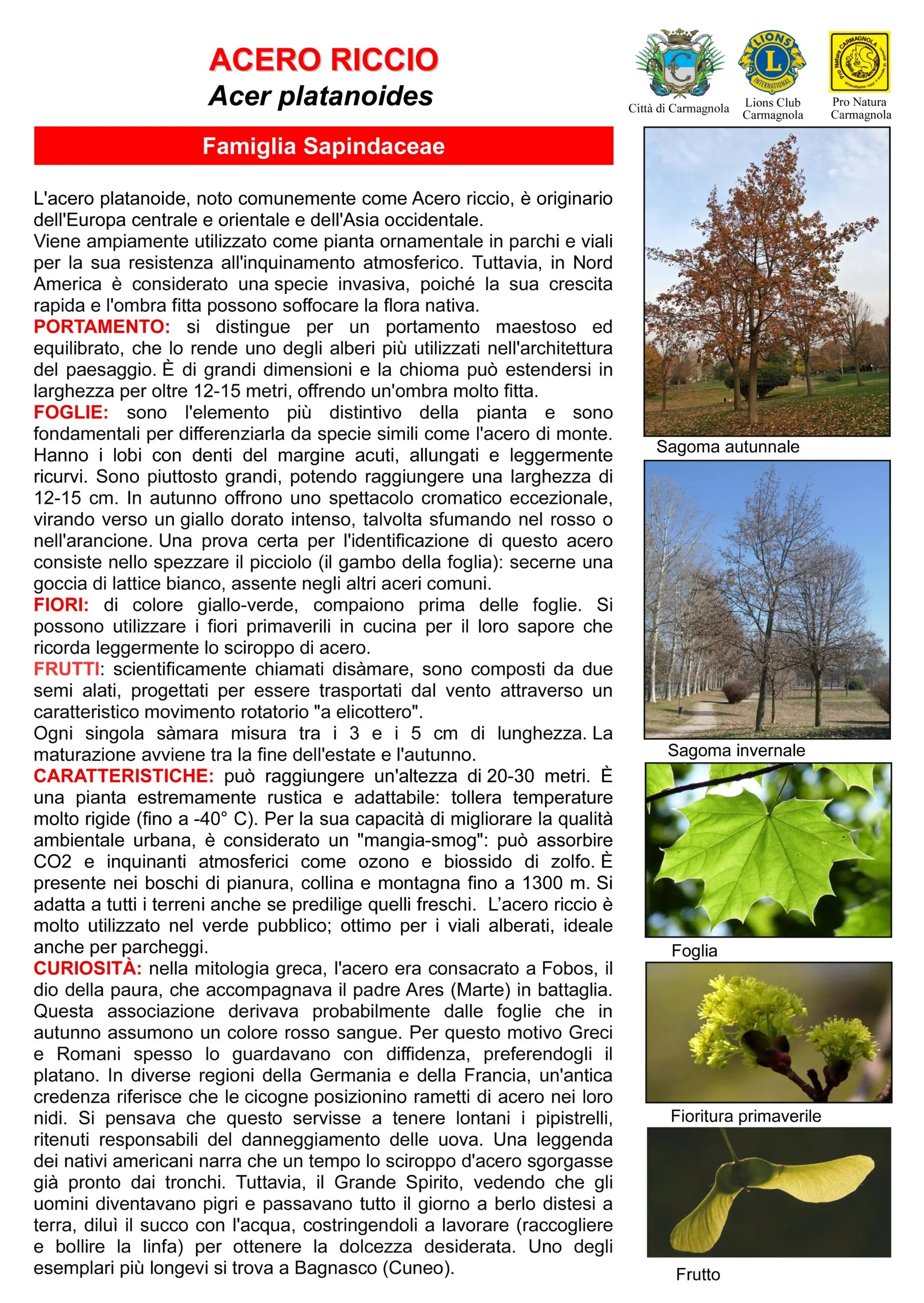
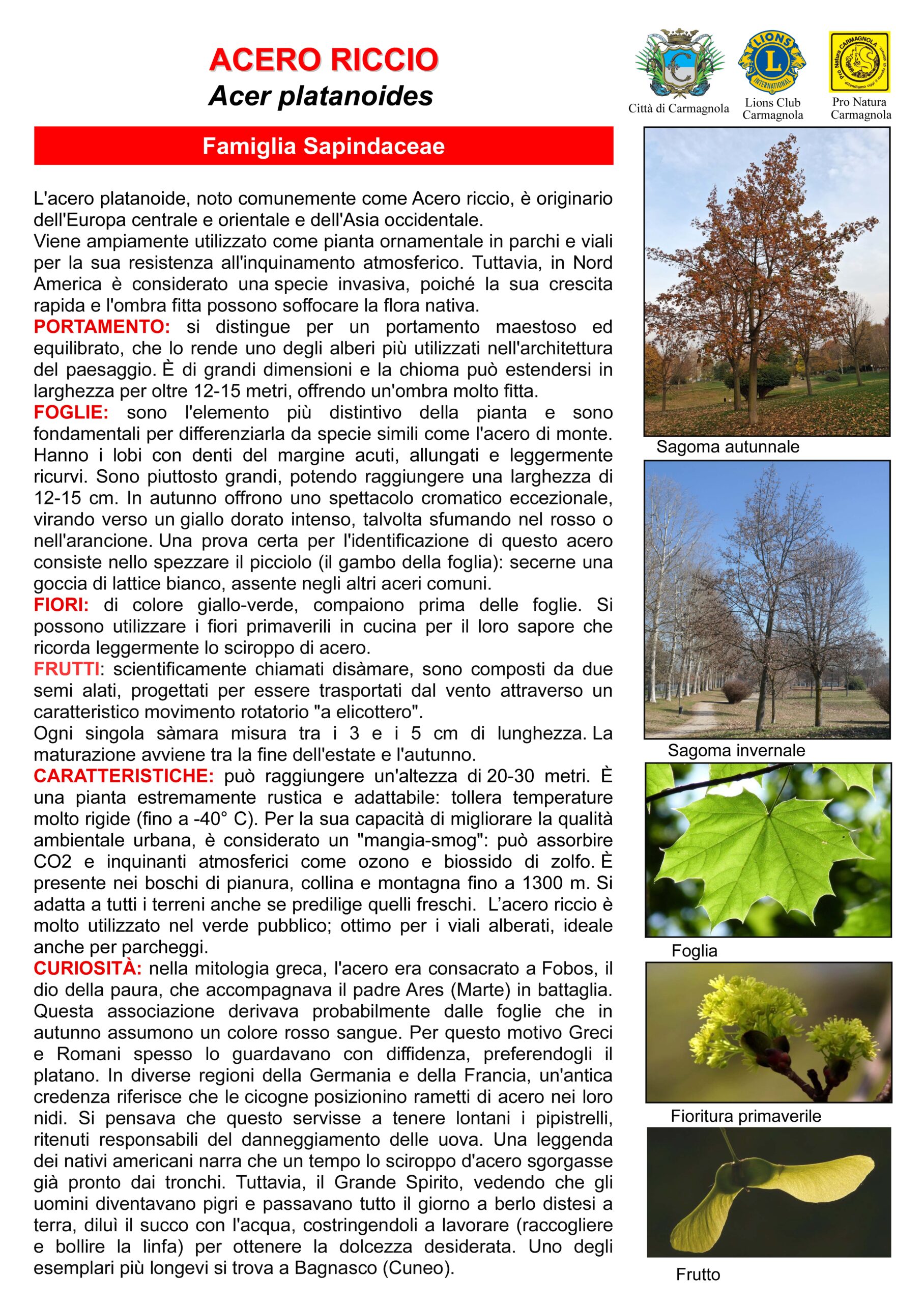
Acer platanoides, commonly known as the Norway maple, is native to central and eastern Europe and western Asia. It is widely used as an ornamental tree in parks and avenues because of its resistance to air pollution. In North America, however, it is considered an invasive species, since its rapid growth and dense shade can smother the native flora.
For children, and not only for them… (video in Italian)
Tree sheet
- Habit
It stands out for its majestic, well-balanced habit, which makes it one of the trees most widely used in landscape architecture. It is a large tree, and the crown can spread to more than 12–15 metres across, giving very dense shade.
- Leaves
They are the most distinctive feature of the plant and are essential for telling it apart from similar species such as the sycamore. The teeth on the margin of the lobes are sharp, elongated and slightly curved. The leaves are rather large and can reach a width of 12–15 cm. In autumn they put on an exceptional display of colour, turning a deep golden yellow, sometimes shading into red or orange. A sure test for identifying this maple is to snap the petiole (the leaf stalk): it exudes a drop of white latex, which is absent in the other common maples.
- Flowers
Yellow-green, they appear before the leaves. The spring flowers can be used in cooking for their flavour, which is slightly reminiscent of maple syrup.
- Fruits
Known scientifically as double samaras, they are made up of two winged seeds, designed to be carried by the wind with a characteristic spinning "helicopter" motion. Each single samara measures between 3 and 5 cm in length. They ripen between late summer and autumn.
- Features
It can reach a height of 20–30 metres. It is an extremely hardy and adaptable plant: it tolerates very harsh temperatures (down to −40 °C). Because of its ability to improve the quality of the urban environment it is regarded as a "smog-eater": it can absorb CO2 and air pollutants such as ozone and sulphur dioxide. It is found in lowland, hill and mountain woods up to 1,300 m. It adapts to all soils, although it prefers cool, moist ones. The Norway maple is widely used in public green spaces; it is excellent for tree-lined avenues and also ideal for car parks.
- Curiosities
In Greek mythology the maple was sacred to Phobos, the god of fear, who accompanied his father Ares (Mars) into battle. This association probably arose from the leaves, which in autumn turn blood red. For this reason the Greeks and Romans often looked on it with distrust and preferred the plane tree. In several regions of Germany and France an old belief has it that storks place maple twigs in their nests. This was thought to keep away bats, which were held responsible for damaging the eggs. A Native American legend tells that maple syrup once flowed ready-made from the trunks. However, the Great Spirit, seeing that people were growing lazy and spent the whole day drinking it stretched out on the ground, diluted the juice with water, forcing them to work (collecting and boiling the sap) to obtain the sweetness they wanted. One of the longest-lived specimens is at Bagnasco (Cuneo).
The original sheet (in Italian)
Show the illustrated sheet