Cascina Vigna Park · tree 16 of 23
Common ash
Fraxinus excelsior
It is found from Europe to Asia Minor and Iran. A deciduous tree, known for its rapid growth and the quality of its timber, in Italy it is found mainly in the northern and central regions, up to an altitude of about 1,200–1,500 metres.
For children, and not only for them… (video in Italian)
Tree sheet
- Habit
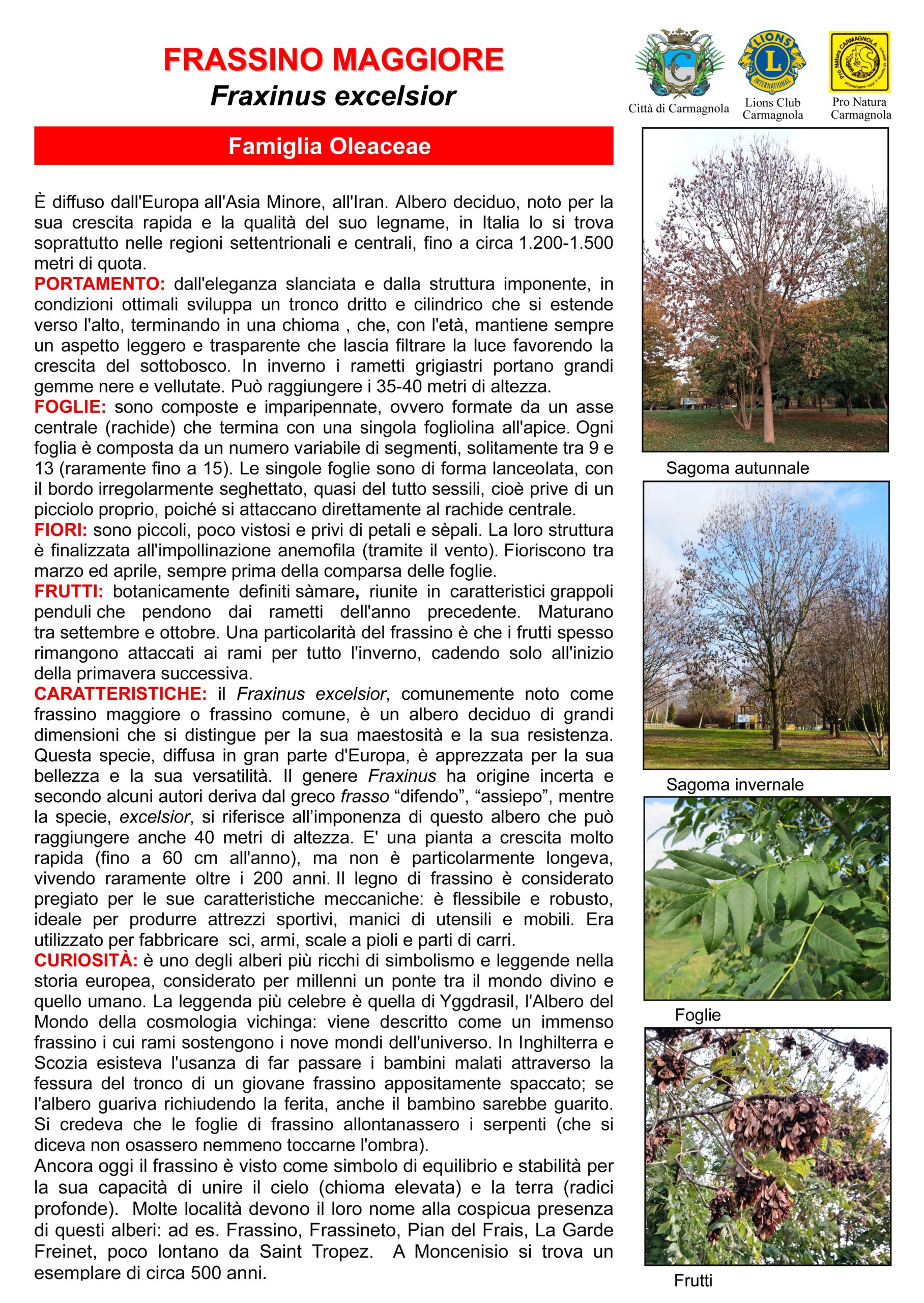
Slender and elegant, with an imposing structure, in ideal conditions it develops a straight, cylindrical trunk that stretches upwards, ending in a crown which, with age, always keeps a light, open look that lets the light through and favours the growth of the undergrowth. In winter the greyish twigs bear large, velvety black buds. It can reach 35–40 metres in height.
- Leaves
They are compound and imparipinnate, that is, formed by a central axis (rachis) ending in a single leaflet at the tip. Each leaf is made up of a variable number of segments, usually between 9 and 13 (rarely up to 15). The individual leaves are lance-shaped, with an irregularly serrated edge, and almost entirely sessile, that is, without a stalk of their own, since they are attached directly to the central rachis.
- Flowers
They are small, inconspicuous and without petals or sepals. Their structure is designed for wind pollination (anemophily). They flower between March and April, always before the leaves appear.
- Fruits
Botanically known as samaras, gathered in characteristic hanging clusters that hang from the previous year's twigs. They ripen between September and October. A peculiarity of the ash is that the fruits often stay attached to the branches all winter, falling only at the beginning of the following spring.
- Features
Fraxinus excelsior, commonly known as common ash or European ash, is a large deciduous tree that stands out for its majesty and its hardiness. This species, widespread across much of Europe, is valued for its beauty and its versatility. The name of the genus, Fraxinus, is of uncertain origin and according to some authors derives from the Greek frasso, "I defend", "I hedge in", while the name of the species, excelsior, refers to the imposing size of this tree, which can reach as much as 40 metres in height. It is a very fast-growing plant (up to 60 cm a year), but it is not especially long-lived, rarely living beyond 200 years. Ash wood is considered valuable for its mechanical properties: it is flexible and strong, ideal for making sports equipment, tool handles and furniture. It was used to make skis, weapons, ladders and parts of carts.
- Curiosities
It is one of the trees richest in symbolism and legend in European history, regarded for thousands of years as a bridge between the divine world and the human one. The most famous legend is that of Yggdrasil, the World Tree of Viking cosmology: it is described as an immense ash whose branches hold up the nine worlds of the universe. In England and Scotland there was a custom of passing sick children through a cleft in the trunk of a young ash split for the purpose; if the tree healed, closing the wound, the child would recover too. Ash leaves were believed to keep snakes away (it was said that they did not even dare to touch its shadow).
Even today the ash is seen as a symbol of balance and stability, for its ability to join the sky (lofty crown) and the earth (deep roots). Many places owe their name to the abundance of these trees: for example Frassino, Frassineto, Pian del Frais and La Garde-Freinet, not far from Saint-Tropez. In Moncenisio there is a specimen about 500 years old.
The original sheet (in Italian)
Show the illustrated sheet