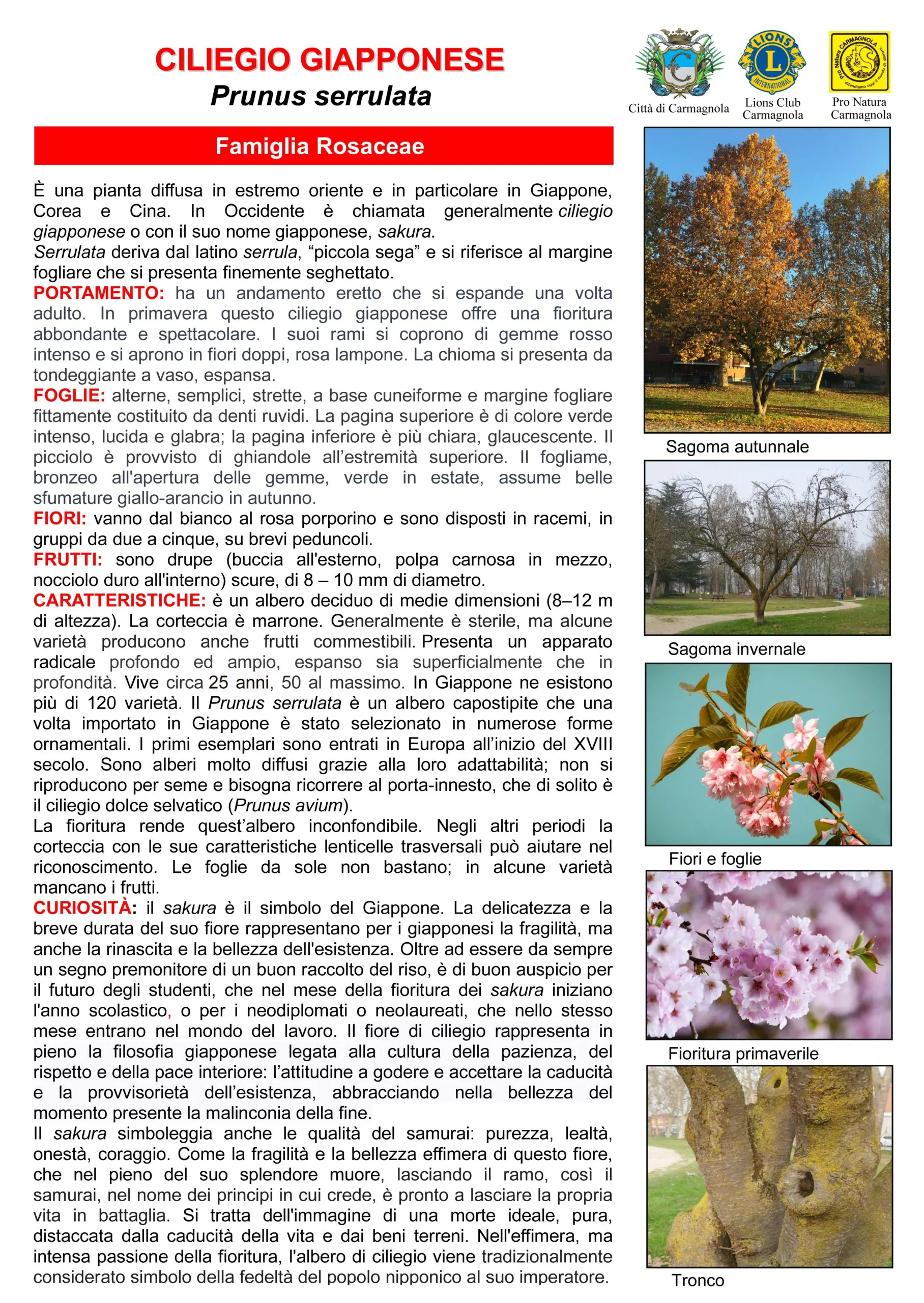
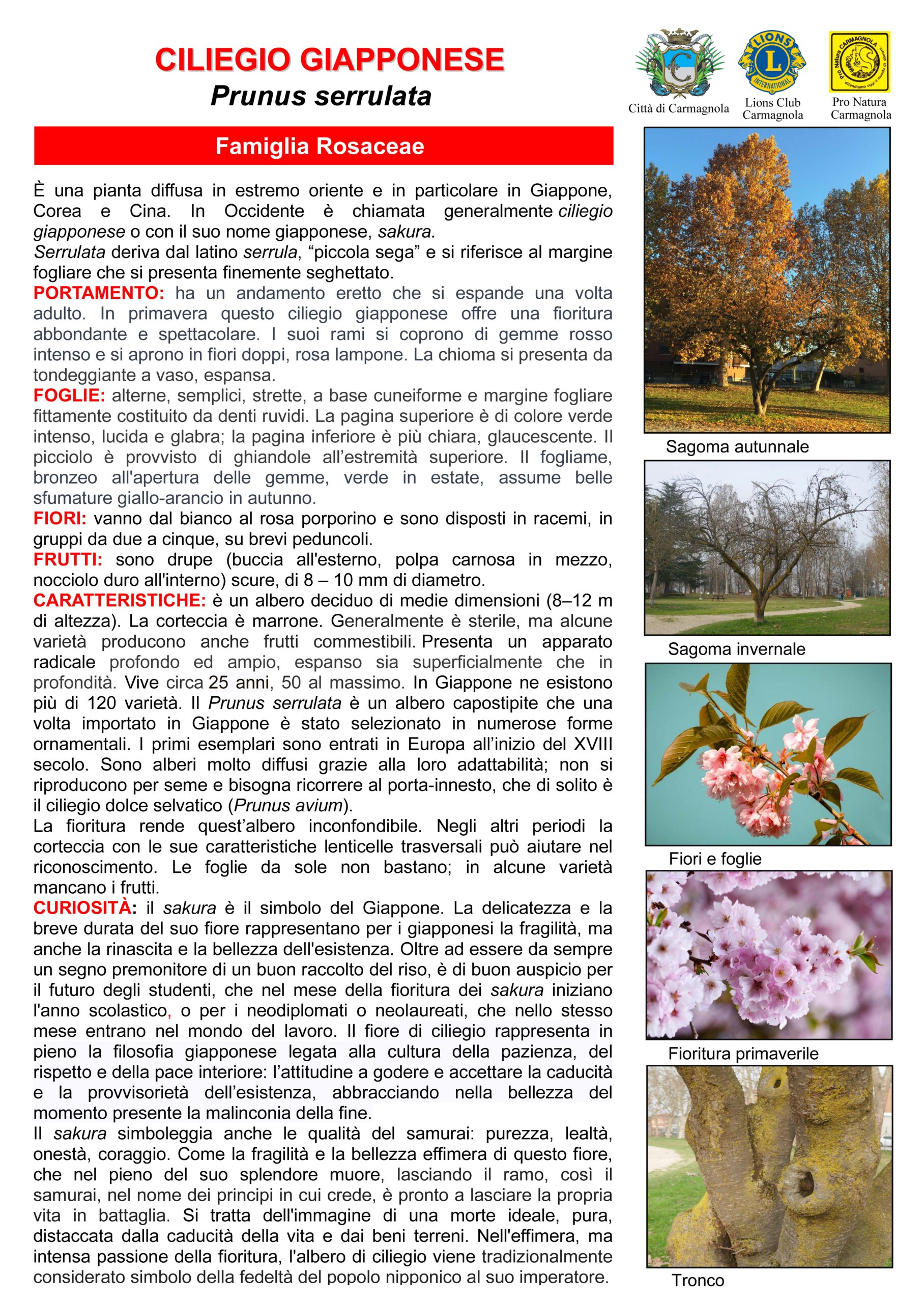
Cascina Vigna Park · tree 02 of 23
Japanese cherry
Prunus serrulata
It is a plant widespread in the Far East, in particular in Japan, Korea and China. In the West it is generally called Japanese cherry or by its Japanese name, sakura.
Serrulata comes from the Latin serrula, "small saw", and refers to the leaf margin, which is finely serrated.
For children, and not only for them… (video in Italian)
Tree sheet
- Habit
It grows upright, spreading once it is mature. In spring this Japanese cherry offers an abundant and spectacular display of blossom. Its branches are covered with deep red buds, which open into double, raspberry-pink flowers. The crown is rounded to vase-shaped, and spreading.
- Leaves
Alternate, simple, narrow, with a wedge-shaped base and a leaf margin densely set with rough teeth. The upper surface is deep green, glossy and hairless; the lower surface is paler and slightly glaucous. The leaf stalk has glands at its upper end. The foliage, bronze when the buds open and green in summer, takes on beautiful yellow-orange shades in autumn.
- Flowers
They range from white to purplish pink and are arranged in racemes, in groups of two to five, on short stalks.
- Fruits
They are dark drupes (skin on the outside, fleshy pulp in the middle, hard stone inside), 8–10 mm in diameter.
- Features
It is a medium-sized deciduous tree (8–12 m tall). The bark is brown. It is generally sterile, but some varieties also produce edible fruits. It has a deep and wide root system, spreading both near the surface and at depth. It lives for about 25 years, 50 at most. In Japan there are more than 120 varieties. Prunus serrulata is a parent species which, once imported into Japan, was selected into many ornamental forms. The first specimens reached Europe at the beginning of the 18th century. These trees are very widespread thanks to their adaptability; they do not reproduce by seed and have to be grafted onto a rootstock, which is usually the wild sweet cherry (Prunus avium).
The blossom makes this tree unmistakable. At other times of the year the bark, with its characteristic horizontal lenticels, can help to identify it. The leaves alone are not enough; in some varieties there are no fruits.
- Curiosities
The sakura is the symbol of Japan. For the Japanese, the delicacy and short life of its flower stand for fragility, but also for the rebirth and beauty of existence. As well as having always been a sign foretelling a good rice harvest, it is a good omen for the future of students, who begin the school year in the month when the sakura are in flower, and for those who have just left school or university, who enter the world of work in the same month. The cherry blossom fully represents the Japanese philosophy bound up with the culture of patience, respect and inner peace: the disposition to enjoy and accept the transience and impermanence of existence, embracing the melancholy of the end in the beauty of the present moment.
The sakura also symbolises the qualities of the samurai: purity, loyalty, honesty, courage. Like the fragility and fleeting beauty of this flower, which dies at the height of its splendour, leaving the branch, so the samurai, in the name of the principles he believes in, is ready to leave his life in battle. It is the image of an ideal death, pure, detached from the transience of life and from earthly goods. In the fleeting but intense passion of its flowering, the cherry tree is traditionally regarded as a symbol of the loyalty of the Japanese people to their emperor.
The original sheet (in Italian)
Show the illustrated sheet