Cascina Vigna Park · tree 14 of 23
Caucasian wingnut
Pterocarya fraxinifolia
Native to the Caucasus region, Armenia, Azerbaijan, Georgia, Turkey, Russia and northern Iran, it is a beautiful, majestic and highly decorative tree.
For children, and not only for them… (video in Italian)
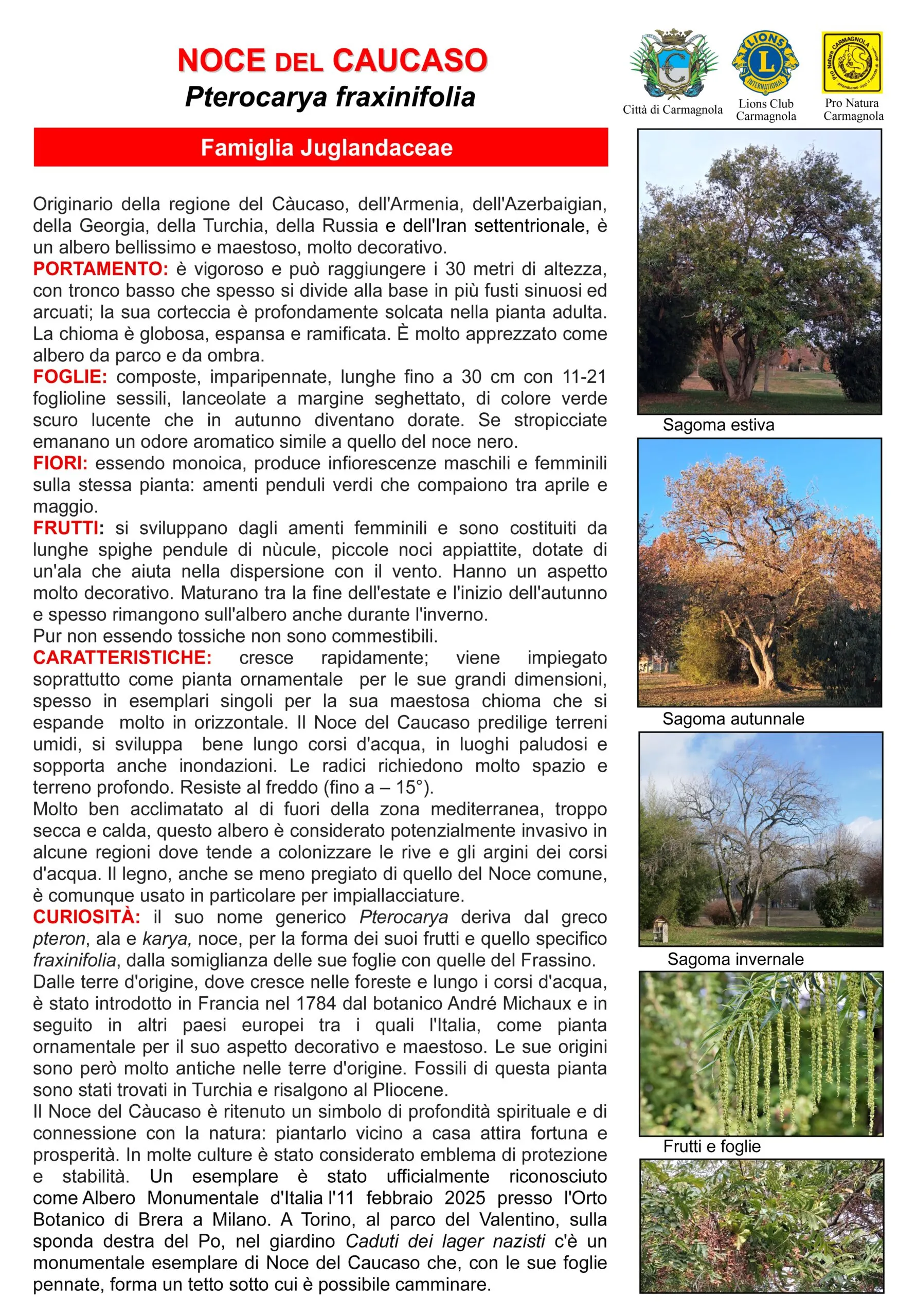
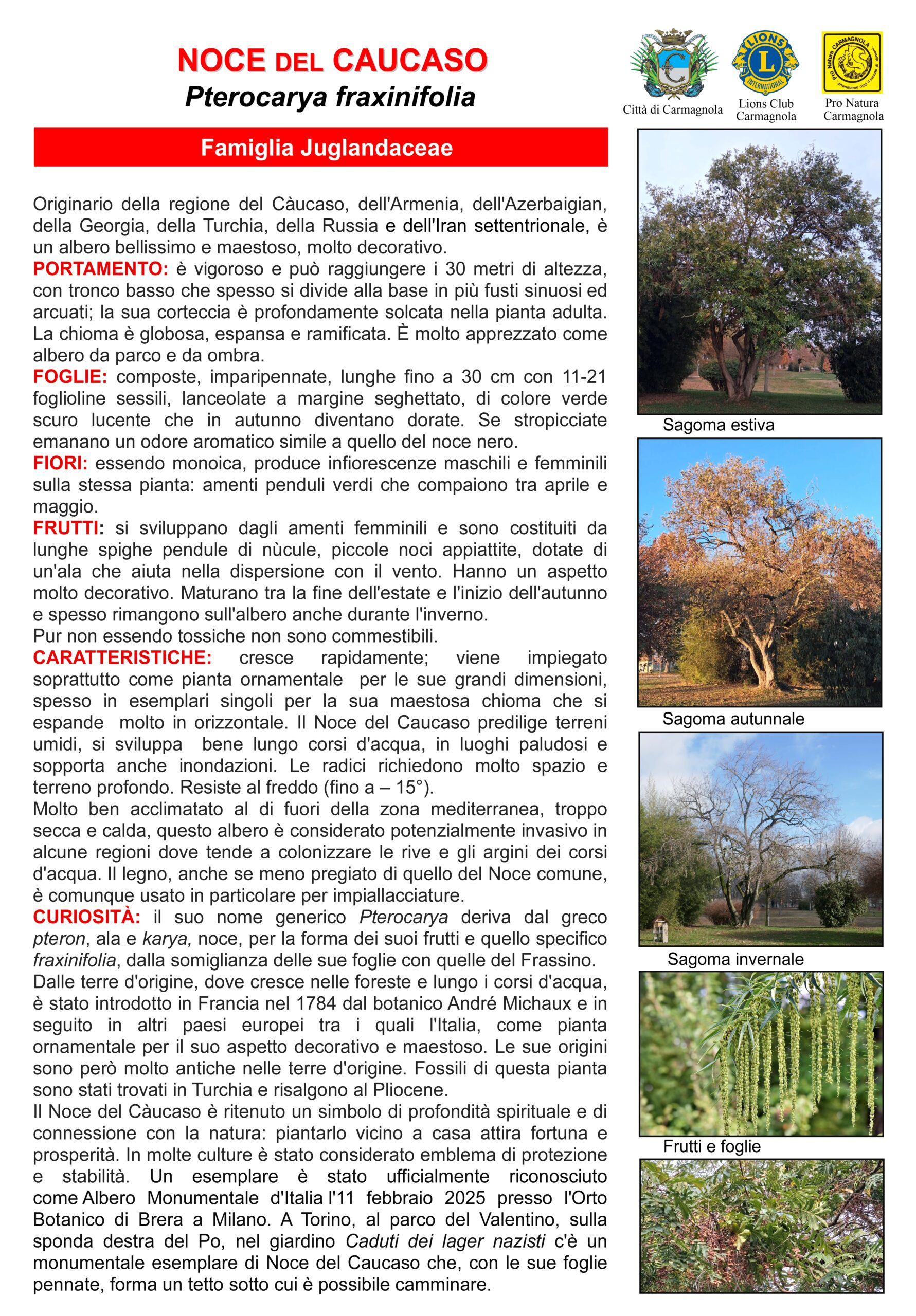
Tree sheet
- Habit
It is vigorous and can reach 30 metres in height, with a short trunk that often divides at the base into several sinuous, arching stems; its bark is deeply furrowed in the mature tree. The crown is globose, spreading and much branched. It is highly valued as a park and shade tree.
- Leaves
Compound, odd-pinnate, up to 30 cm long, with 11–21 sessile, lanceolate leaflets with a serrated margin, glossy dark green and turning golden in autumn. When crushed they give off an aromatic smell similar to that of the black walnut.
- Flowers
Being monoecious, it produces male and female inflorescences on the same plant: green hanging catkins that appear between April and May.
- Fruits
They develop from the female catkins and consist of long hanging spikes of nutlets, small flattened nuts with a wing that helps them to be dispersed by the wind. They are very decorative. They ripen between late summer and early autumn and often stay on the tree through the winter as well. Although not poisonous, they are not edible.
- Features
It grows quickly; it is used mainly as an ornamental plant on account of its great size, often as a single specimen for its majestic crown, which spreads very widely. The Caucasian wingnut prefers moist soils; it grows well along watercourses and in marshy places, and even withstands floods. The roots need plenty of room and deep soil. It is resistant to cold (down to −15 °C). Very well acclimatised outside the Mediterranean zone, which is too dry and hot, this tree is considered potentially invasive in some regions, where it tends to colonise the banks and embankments of watercourses. The timber, though less prized than that of the common walnut, is nevertheless used, in particular for veneers.
- Curiosities
Its generic name Pterocarya comes from the Greek pteron, wing, and karya, nut, after the shape of its fruits, and the specific name fraxinifolia from the resemblance of its leaves to those of the ash. From its native lands, where it grows in forests and along watercourses, it was introduced into France in 1784 by the botanist André Michaux and later into other European countries, including Italy, as an ornamental plant for its decorative and majestic appearance. Its origins in its native lands, however, are very ancient. Fossils of this plant have been found in Turkey and date back to the Pliocene. The Caucasian wingnut is regarded as a symbol of spiritual depth and of connection with nature: planting it near the house brings luck and prosperity. In many cultures it has been considered an emblem of protection and stability. One specimen, at the Brera Botanical Garden in Milan, was officially recognised as an Albero Monumentale d'Italia (Monumental Tree of Italy) on 11 February 2025. In Turin, in the Parco del Valentino, on the right bank of the Po, in the garden Caduti dei lager nazisti ("The fallen of the Nazi camps"), there is a monumental Caucasian wingnut which, with its pinnate leaves, forms a roof under which one can walk.
The original sheet (in Italian)
Show the illustrated sheet