Cascina Vigna Park · tree 10 of 23
Weymouth pine
Pinus strobus
It is native to North America, in the area between Canada and the United States. It was brought to Europe in the 1700s by Lord Weymouth as a forestry tree, and today it is used for reforestation or as an ornamental tree in parks and gardens. The generic name is the one used by the Romans for the Mediterranean pine and derives from the Latin pix, picis (pitch, resin, the exudate of the plant), from pic (to prick) or pi (to drip), or else from the Celtic pen (head), from the shape of the trees' crown. The specific name derives from the Latin stróbilus (spinning top, pine cone) and refers to the markedly elongated cones.
For children, and not only for them… (video in Italian)
Tree sheet
- Habit
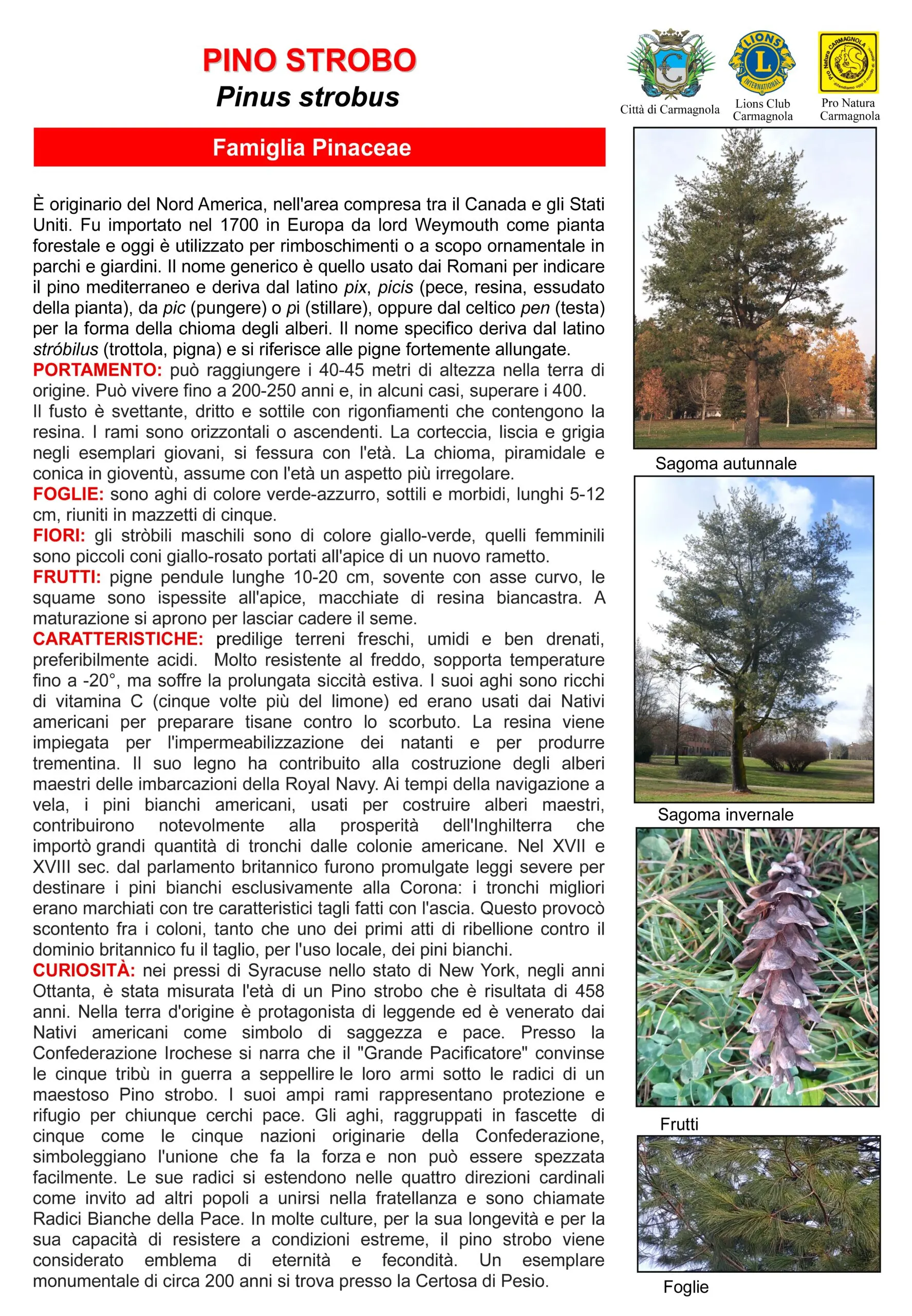
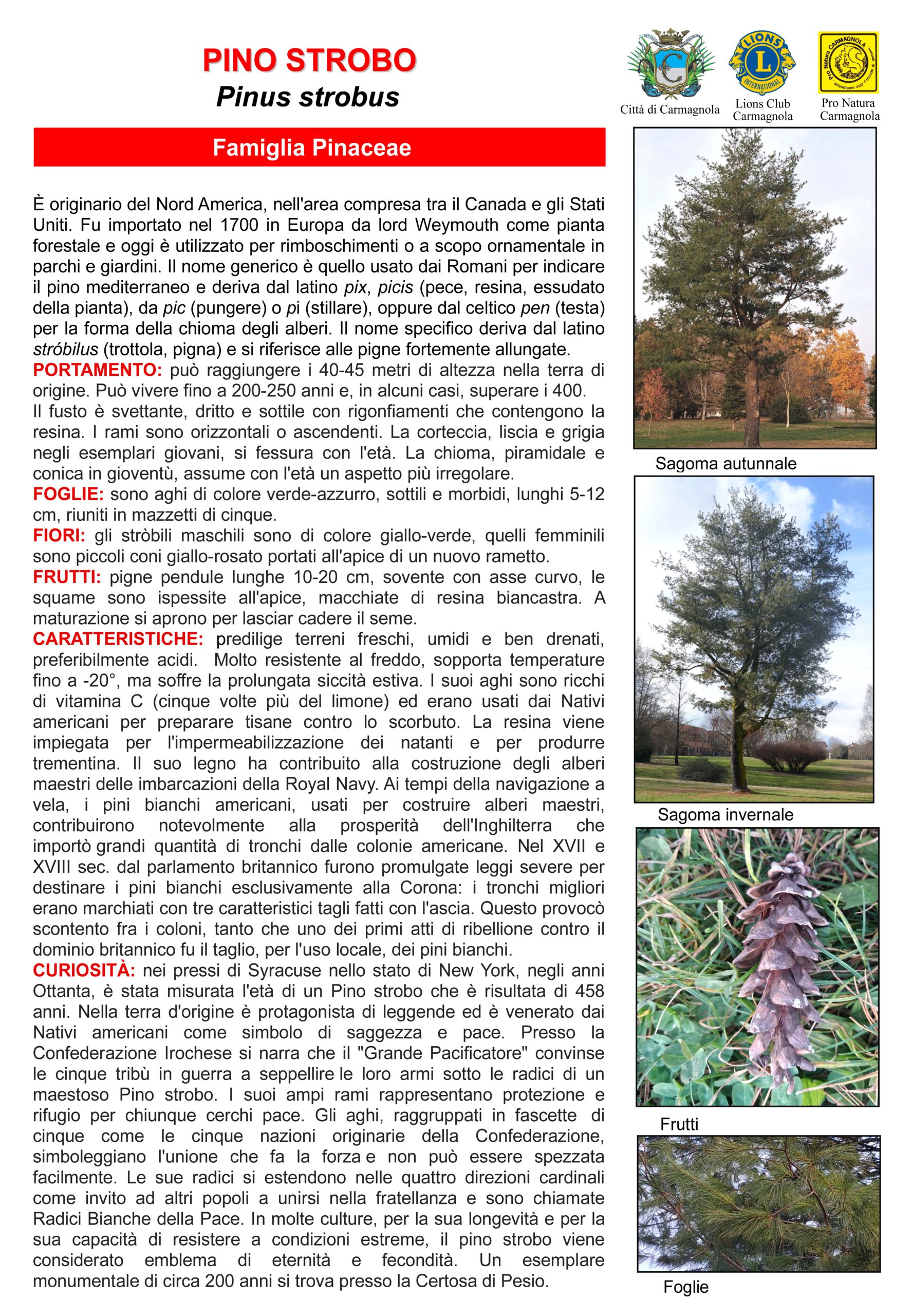
It can reach 40–45 metres in height in its native land. It can live for 200–250 years and, in some cases, for more than 400. The trunk is soaring, straight and slender, with swellings that contain the resin. The branches are horizontal or ascending. The bark, smooth and grey in young trees, fissures with age. The crown, pyramidal and conical when young, takes on a more irregular appearance with age.
- Leaves
They are blue-green needles, thin and soft, 5–12 cm long, in bundles of five.
- Flowers
The male strobili are yellow-green; the female ones are small pinkish-yellow cones borne at the tip of a new shoot.
- Fruits
Pendulous cones 10–20 cm long, often with a curved axis; the scales are thickened at the tip and stained with whitish resin. When ripe they open to let the seed fall.
- Features
It prefers cool, moist, well-drained soils, preferably acid ones. Very hardy, it withstands temperatures down to −20 °C, but suffers in prolonged summer drought. Its needles are rich in vitamin C (five times more than lemon) and were used by Native Americans to make infusions against scurvy. The resin is used for waterproofing boats and for making turpentine. Its wood went into the mainmasts of the ships of the Royal Navy. In the days of sail, American white pines, used to make mainmasts, contributed considerably to the prosperity of England, which imported large quantities of trunks from the American colonies. In the 17th and 18th centuries the British parliament passed strict laws reserving white pines exclusively for the Crown: the best trunks were marked with three characteristic cuts made with an axe. This caused discontent among the colonists, so much so that one of the first acts of rebellion against British rule was the felling of white pines for local use.
- Curiosities
Near Syracuse in the state of New York, in the 1980s, the age of a Weymouth pine was measured and found to be 458 years. In its native land it features in legends and is venerated by Native Americans as a symbol of wisdom and peace. In the Iroquois Confederacy the story is told that the "Great Peacemaker" persuaded the five warring tribes to bury their weapons beneath the roots of a majestic Weymouth pine. Its broad branches stand for protection and shelter for anyone seeking peace. The needles, grouped in bundles of five like the five original nations of the Confederacy, symbolise the unity that gives strength and cannot easily be broken. Its roots spread in the four cardinal directions as an invitation to other peoples to join in brotherhood, and are called the White Roots of Peace. In many cultures, because of its longevity and its ability to withstand extreme conditions, the Weymouth pine is regarded as an emblem of eternity and fertility. A monumental specimen about 200 years old stands at the Certosa di Pesio (the Charterhouse of Pesio).
The original sheet (in Italian)
Show the illustrated sheet