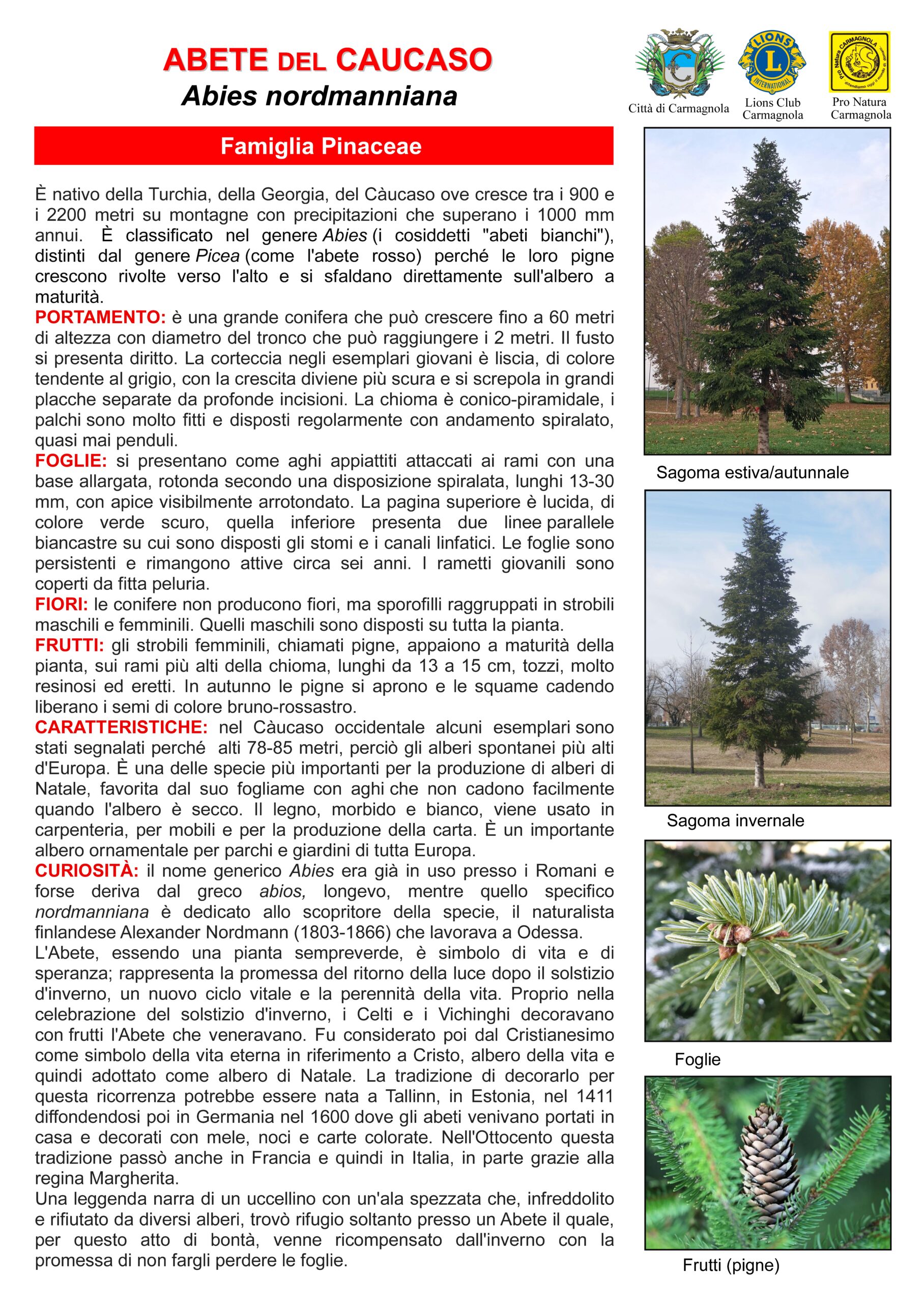
Cascina Vigna Park · tree 09 of 23
Nordmann fir
Abies nordmanniana
It is native to Turkey, Georgia and the Caucasus, where it grows between 900 and 2,200 metres on mountains with rainfall of more than 1,000 mm a year. It is classified in the genus Abies (the so-called "silver firs"), which differ from the genus Picea (such as the Norway spruce) in that their cones grow pointing upwards and break up on the tree itself when ripe.
For children, and not only for them… (video in Italian)
Tree sheet
- Habit
It is a large conifer that can grow up to 60 metres tall, with a trunk that can reach 2 metres in diameter. The trunk is straight. In young trees the bark is smooth and greyish; as the tree grows it becomes darker and cracks into large plates separated by deep fissures. The crown is conical-pyramidal; the tiers of branches are very dense and regularly arranged in a spiral pattern, and hardly ever drooping.
- Leaves
They are flattened needles attached to the branches by a broad, round base in a spiral arrangement, 13–30 mm long, with a visibly rounded tip. The upper surface is glossy and dark green; the lower one has two parallel whitish lines along which the stomata and the sap canals are arranged. The leaves are persistent and remain active for about six years. The young twigs are covered with dense down.
- Flowers
Conifers do not produce flowers, but sporophylls grouped into male and female strobili. The male ones are borne all over the tree.
- Fruits
The female strobili, known as cones, appear once the tree is mature, on the highest branches of the crown; they are 13 to 15 cm long, squat, very resinous and upright. In autumn the cones open and the scales, as they fall, release the reddish-brown seeds.
- Features
In the western Caucasus some specimens have been recorded as being 78–85 metres tall, which makes them the tallest native trees in Europe. It is one of the most important species for the production of Christmas trees, favoured for its foliage, with needles that do not drop easily when the tree dries out. The wood, soft and white, is used in carpentry, for furniture and for making paper. It is an important ornamental tree for parks and gardens throughout Europe.
- Curiosities
The generic name Abies was already in use among the Romans and perhaps derives from the Greek abios, long-lived, while the specific name nordmanniana honours the discoverer of the species, the Finnish naturalist Alexander Nordmann (1803–1866), who worked in Odessa. The fir, being an evergreen, is a symbol of life and hope; it stands for the promise of the return of the light after the winter solstice, a new cycle of life and the everlasting nature of life. It was precisely to celebrate the winter solstice that the Celts and the Vikings decorated the fir, which they worshipped, with fruit. Christianity later regarded it as a symbol of eternal life with reference to Christ, the tree of life, and so it was adopted as the Christmas tree. The tradition of decorating it for this festival may have begun in Tallinn, Estonia, in 1411, later spreading to Germany in the 1600s, where firs were brought indoors and decorated with apples, nuts and coloured paper. In the 19th century this tradition also passed to France and then to Italy, partly thanks to Queen Margherita. A legend tells of a little bird with a broken wing which, numb with cold and turned away by several trees, found shelter only with a fir; for this act of kindness the fir was rewarded by winter with the promise that it would never lose its leaves.
The original sheet (in Italian)
Show the illustrated sheet