Cascina Vigna Park · tree 22 of 23
Judas tree
Cercis siliquastrum
It is an ornamental tree known for its spectacular spring flowering, which comes before the leaves. Native to the eastern Mediterranean and the Middle East, it is found throughout Italy, from the coasts of the south (such as the Amalfi Coast) to the north, with notable specimens also in Rome (Palatine Hill) and in the Euganean Hills.
For children, and not only for them… (video in Italian)
Tree sheet
- Habit
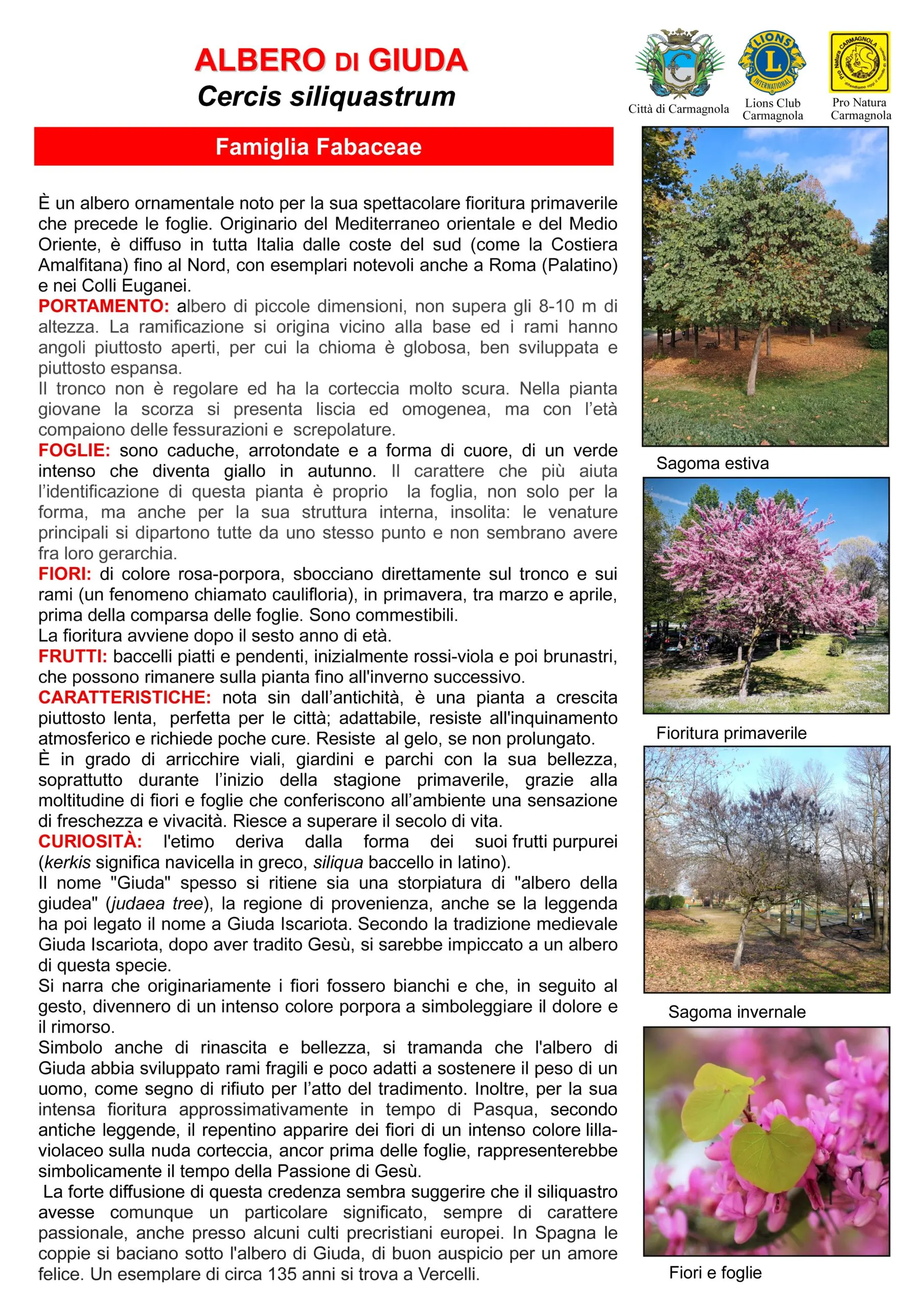
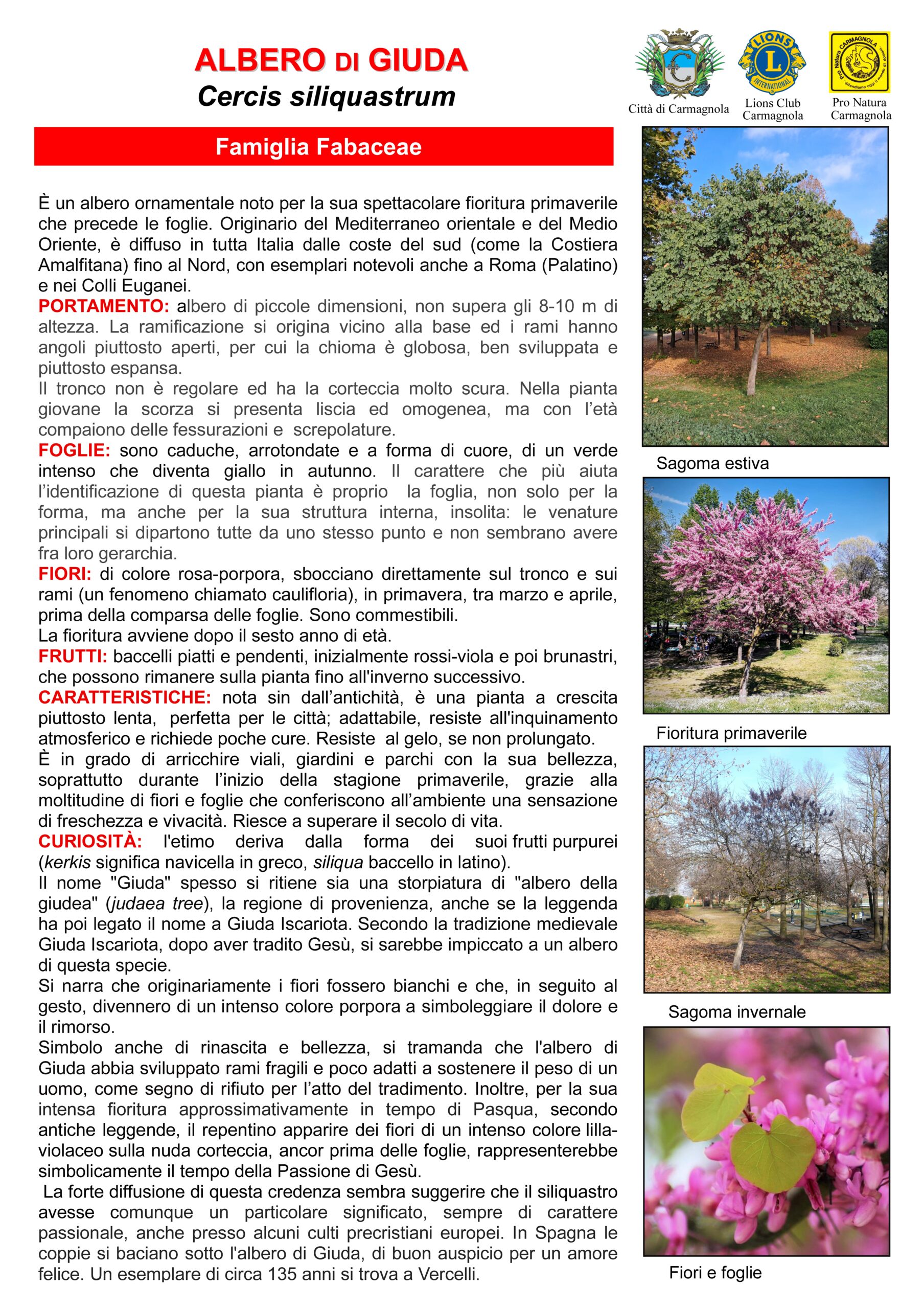
A small tree, no more than 8–10 m tall. Branching starts close to the base and the branches are set at rather wide angles, so the crown is rounded, well developed and rather spreading. The trunk is irregular and has very dark bark. In young trees the bark is smooth and even, but with age fissures and cracks appear.
- Leaves
They are deciduous, rounded and heart-shaped, of a deep green that turns yellow in autumn. The feature that most helps to identify this plant is the leaf itself, not only for its shape but also for its unusual internal structure: the main veins all radiate from a single point and seem to have no hierarchy among them.
- Flowers
Pinkish-purple, they open directly on the trunk and branches (a phenomenon called cauliflory) in spring, between March and April, before the leaves appear. They are edible. The tree flowers after its sixth year.
- Fruits
Flat, hanging pods, reddish-purple at first and then brownish, which may remain on the tree until the following winter.
- Features
Known since antiquity, it is a rather slow-growing plant, perfect for towns and cities; it is adaptable, withstands air pollution and needs little care. It withstands frost, provided it is not prolonged. It can enrich avenues, gardens and parks with its beauty, especially at the beginning of spring, thanks to the multitude of flowers and leaves that give the surroundings a feeling of freshness and liveliness. It can live for more than a century.
- Curiosities
The name derives from the shape of its purple fruits (kerkis means shuttle in Greek, siliqua pod in Latin). The name "Judas" is often thought to be a corruption of "tree of Judaea" (Judaea tree), the region it comes from, although legend later linked the name to Judas Iscariot. According to medieval tradition Judas Iscariot, after betraying Jesus, hanged himself from a tree of this species. It is said that the flowers were originally white and that, after this act, they turned a deep purple to symbolise grief and remorse. Also a symbol of rebirth and beauty, the Judas tree is said to have developed brittle branches, ill-suited to bearing the weight of a man, as a sign of rejection of the act of betrayal. Moreover, because it flowers so profusely at about Easter time, according to ancient legends the sudden appearance of flowers of a deep lilac-violet on the bare bark, even before the leaves, symbolically represents the time of the Passion of Jesus. The wide spread of this belief seems to suggest that the Judas tree in any case had a special meaning, again to do with passion, in some pre-Christian European cults as well. In Spain couples kiss under the Judas tree, as a good omen for a happy love. A specimen about 135 years old is in Vercelli.
The original sheet (in Italian)
Show the illustrated sheet