Cascina Vigna Park · tree 01 of 23
Ginkgo
Ginkgo biloba
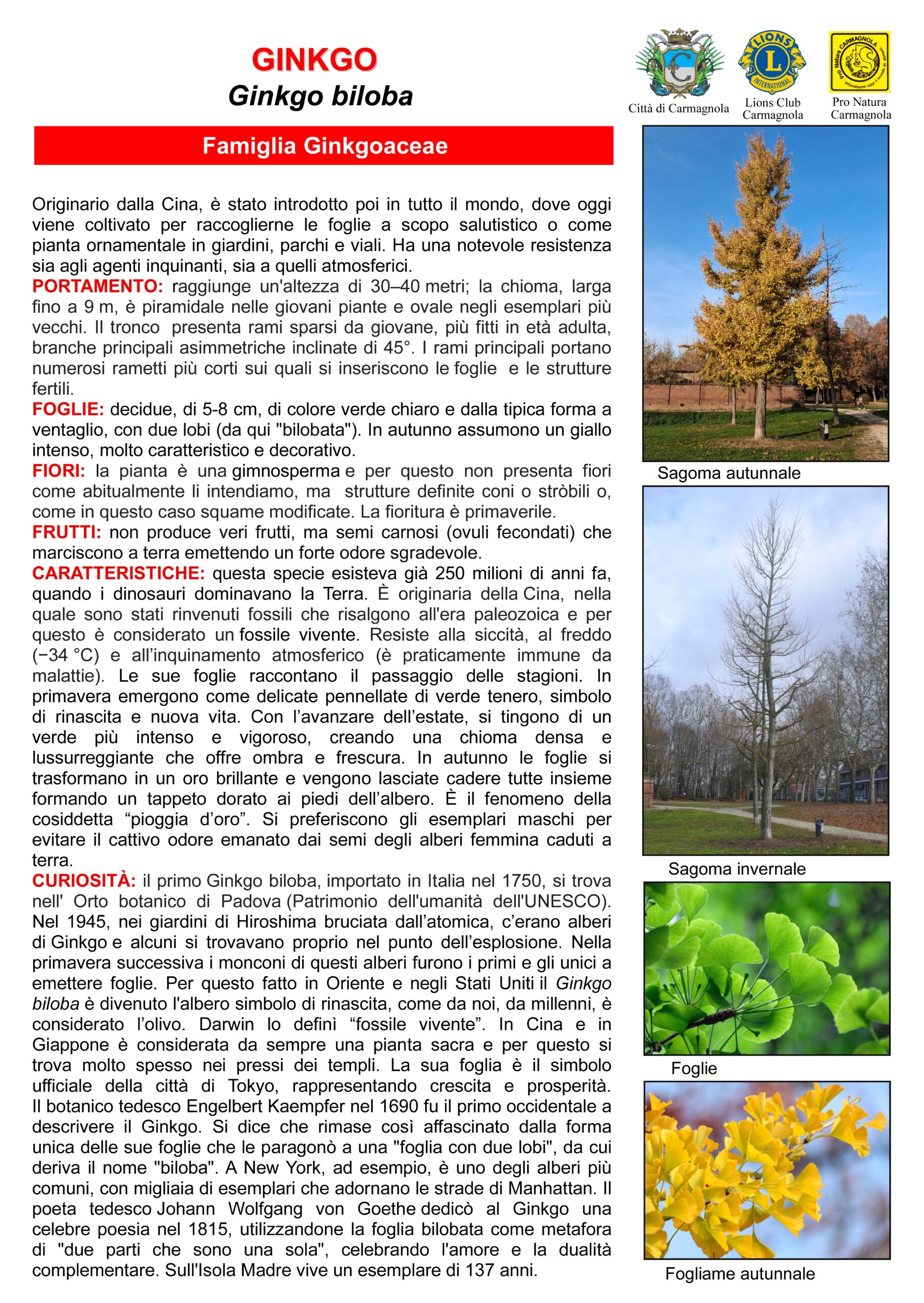
Native to China, it was later introduced all over the world, where it is now grown for its leaves, which are used in health products, or as an ornamental tree in gardens, parks and avenues. It is remarkably resistant both to pollutants and to the weather.
For children, and not only for them… (video in Italian)
Tree sheet
- Habit
It reaches a height of 30–40 metres; the crown, up to 9 m wide, is pyramidal in young trees and oval in older ones. The trunk has sparse branches when young and denser ones when mature, with asymmetrical main limbs set at an angle of 45°. The main branches bear many shorter shoots, which carry the leaves and the fertile structures.
- Leaves
Deciduous, 5–8 cm long, light green and with the typical fan shape, with two lobes (hence "biloba"). In autumn they turn a deep yellow, very distinctive and decorative.
- Flowers
The plant is a gymnosperm and so does not have flowers as we usually think of them, but structures known as cones or strobili or, as in this case, modified scales. It flowers in spring.
- Fruits
It does not produce true fruits, but fleshy seeds (fertilised ovules) that rot on the ground, giving off a strong unpleasant smell.
- Features
This species already existed 250 million years ago, when dinosaurs ruled the Earth. It is native to China, where fossils dating back to the Palaeozoic era have been found, which is why it is regarded as a living fossil. It withstands drought, cold (−34 °C) and air pollution (it is practically immune to disease). Its leaves tell the story of the passing seasons. In spring they emerge like delicate brushstrokes of tender green, a symbol of rebirth and new life. As summer advances they take on a deeper, more vigorous green, forming a dense, luxuriant crown that gives shade and coolness. In autumn the leaves turn a brilliant gold and are shed all at once, forming a golden carpet at the foot of the tree. This is the phenomenon known as the "golden rain". Male trees are preferred, to avoid the bad smell given off by the seeds that fall from female trees.
- Curiosities
The first Ginkgo biloba brought to Italy, in 1750, is in the Botanical Garden of Padua (a UNESCO World Heritage Site). In 1945, in the gardens of Hiroshima burnt by the atomic bomb, there were Ginkgo trees, and some of them stood at the very point of the explosion. The following spring the stumps of these trees were the first and the only ones to put out leaves. For this reason, in the East and in the United States Ginkgo biloba has become the tree that symbolises rebirth, as the olive tree has been for us for thousands of years. Darwin called it a "living fossil". In China and Japan it has always been regarded as a sacred plant, and so it is very often found near temples. Its leaf is the official symbol of the city of Tokyo, standing for growth and prosperity. In 1690 the German botanist Engelbert Kaempfer was the first Westerner to describe the Ginkgo. He is said to have been so fascinated by the unique shape of its leaves that he compared them to a "leaf with two lobes", which is where the name "biloba" comes from. In New York, for example, it is one of the most common trees, with thousands of specimens lining the streets of Manhattan. The German poet Johann Wolfgang von Goethe dedicated a famous poem to the Ginkgo in 1815, using its two-lobed leaf as a metaphor for "two parts that are one", in celebration of love and complementary duality. A 137-year-old specimen lives on Isola Madre.
The original sheet (in Italian)
Show the illustrated sheet