Cascina Vigna Park · tree 05 of 23
Siberian elm
Ulmus pumila
It is a tree native to eastern Siberia, northern China, Manchuria and Korea, introduced into Europe in the second half of the 19th century. In temperate climates it is relatively short-lived, rarely exceeding 60 years, but in its native environment it can live for between 100 and 150 years. The name was given by the Swedish botanist Linnaeus in the celebrated Species Plantarum, Stockholm, 1753.
For children, and not only for them… (video in Italian)
Tree sheet
- Habit
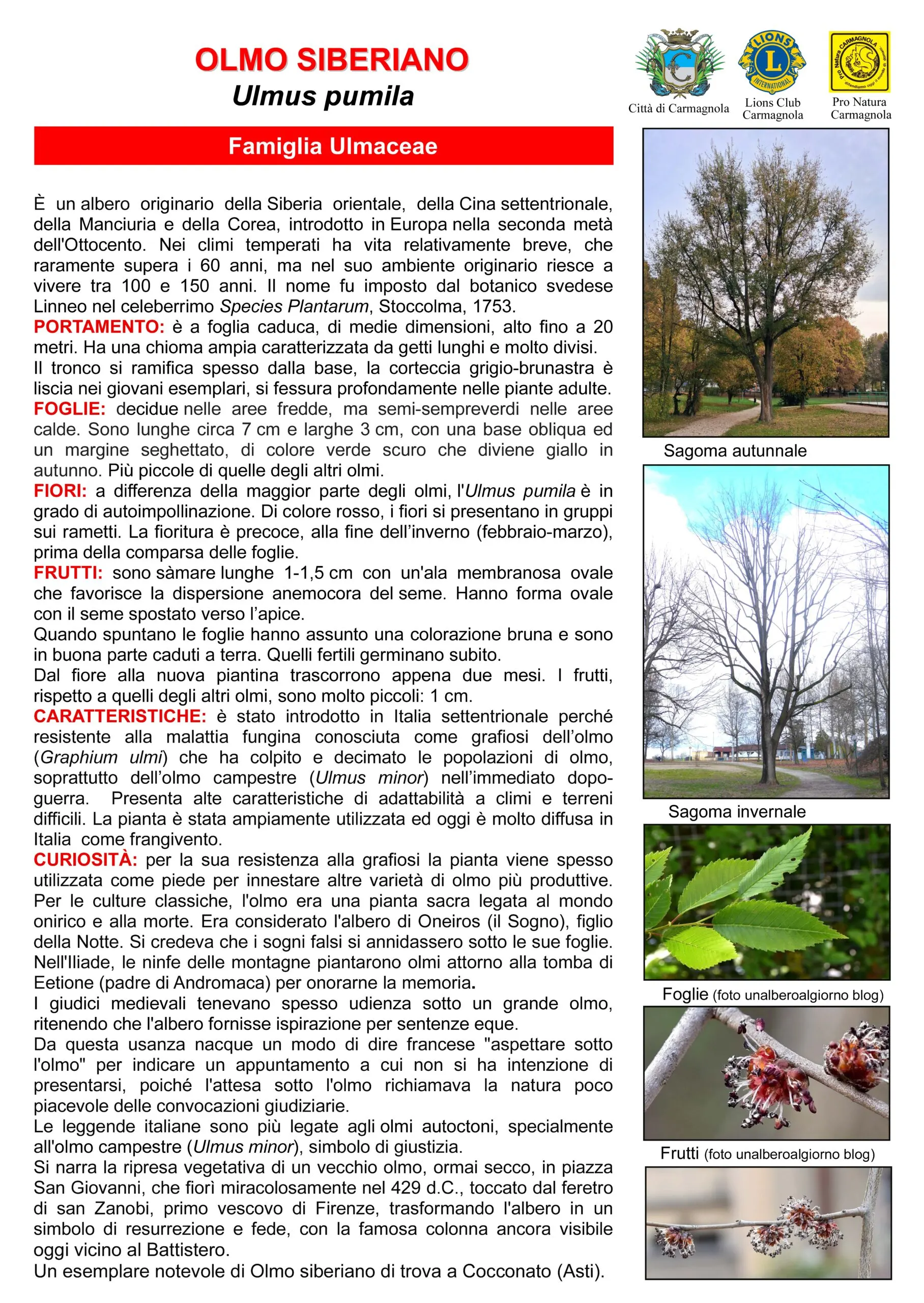
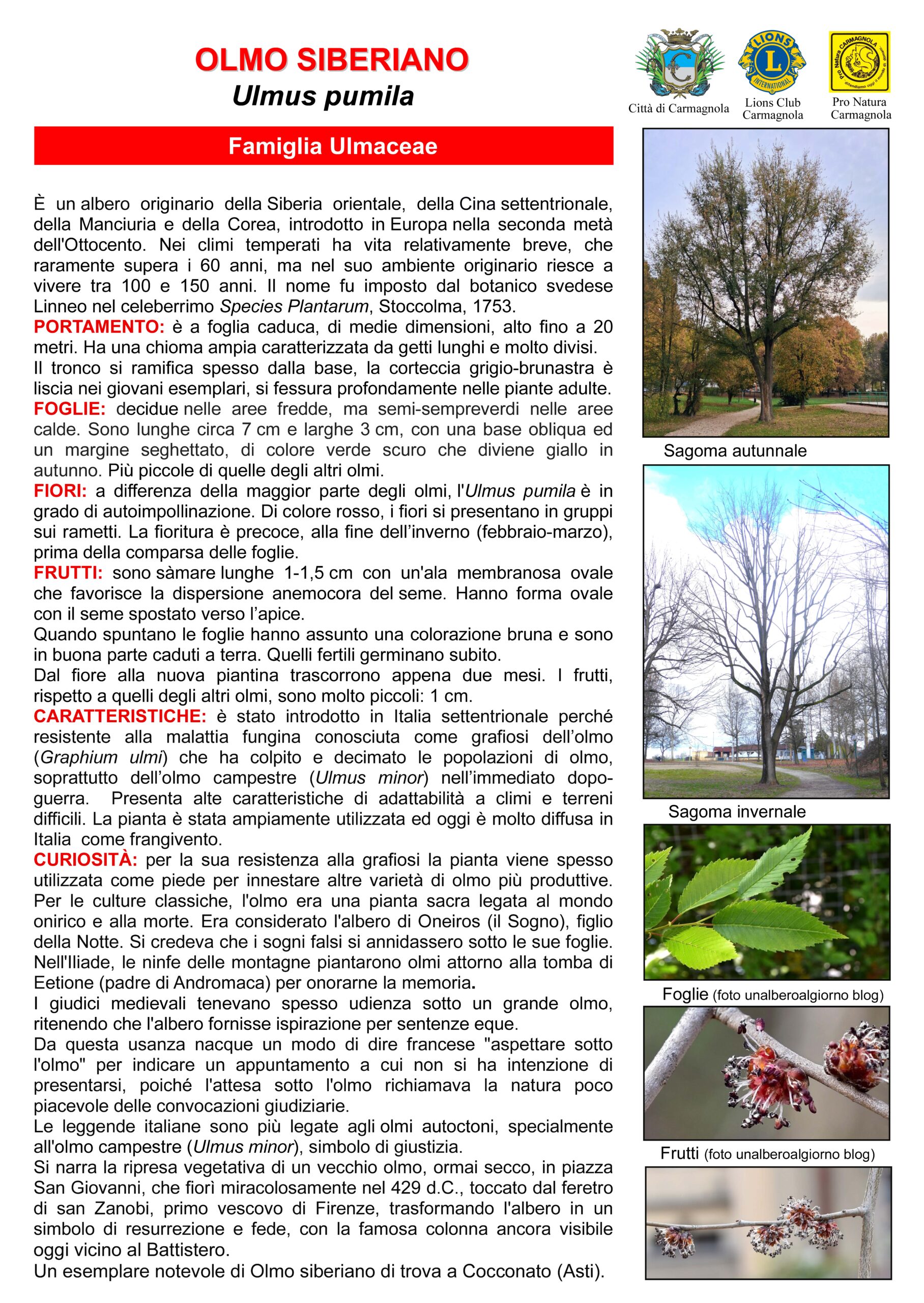
It is deciduous and medium-sized, up to 20 metres tall. It has a broad crown characterised by long, much-divided shoots. The trunk often branches from the base; the greyish-brown bark is smooth in young trees and becomes deeply fissured in mature ones.
- Leaves
Deciduous in cold areas, but semi-evergreen in warm ones. They are about 7 cm long and 3 cm wide, with an oblique base and a serrated margin, dark green and turning yellow in autumn. They are smaller than those of the other elms.
- Flowers
Unlike most elms, Ulmus pumila is capable of self-pollination. Red in colour, the flowers are borne in clusters on the twigs. Flowering is early, at the end of winter (February–March), before the leaves appear.
- Fruits
They are samaras 1–1.5 cm long, with an oval membranous wing that helps the seed to be dispersed by the wind. They are oval in shape, with the seed set towards the tip. By the time the leaves come out they have turned brown and have largely fallen to the ground. The fertile ones germinate straight away. Barely two months pass from the flower to the new seedling. Compared with those of the other elms, the fruits are very small: 1 cm.
- Features
It was introduced into northern Italy because it is resistant to the fungal disease known as Dutch elm disease (Graphium ulmi), which struck and decimated elm populations, especially those of the field elm (Ulmus minor), in the years immediately after the war. It is highly adaptable to difficult climates and soils. The plant has been widely used and is now very common in Italy as a windbreak.
- Curiosities
Because of its resistance to Dutch elm disease, the plant is often used as a rootstock on which to graft other, more productive varieties of elm. In classical cultures the elm was a sacred plant linked to the world of dreams and to death. It was regarded as the tree of Oneiros (Dream), son of Night. False dreams were believed to nestle beneath its leaves. In the Iliad, the mountain nymphs planted elms around the tomb of Eetion (the father of Andromache) to honour his memory. Medieval judges often held court under a large elm, believing that the tree provided inspiration for fair judgements. This custom gave rise to a French saying, "to wait under the elm", for an appointment that one has no intention of keeping, since waiting under the elm recalled the unpleasant nature of a summons to court. Italian legends have more to do with the native elms, especially the field elm (Ulmus minor), a symbol of justice. The story is told of an old elm in Piazza San Giovanni, by then dead and dry, which came back into growth and miraculously flowered in AD 429 when it was touched by the bier of St Zenobius, the first bishop of Florence; this turned the tree into a symbol of resurrection and faith, with the famous column still to be seen today near the Baptistery. A notable specimen of Siberian elm stands at Cocconato (Asti).
The original sheet (in Italian)
Show the illustrated sheet