Cascina Vigna Park · tree 06 of 23
Sweet gum
Liquidambar styraciflua
Native to the Atlantic side of North America and to Central America, the sweet gum, or American storax, was introduced into Europe in 1681 by the missionary John Banister (1650–1692). In Italy it is used solely as an ornamental tree.
For children, and not only for them… (video in Italian)
Tree sheet
- Habit
It can reach a height of over 25–35 metres. The trunk is straight and slender; the bark changes colour with age, from grey to dark brown, and is fissured. The crown, pyramidal or rounded depending on age, can reach a diameter of 10 metres.
- Leaves
Deciduous, alternate, five-lobed, with a serrated margin and a long leaf stalk; green in summer, they turn yellow, orange, red and purplish in autumn.
- Flowers
Unisexual; the male flowers, arranged in racemes, are round and yellow; the female ones are small and gathered in a dense, solitary, hanging inflorescence. It flowers in April–May.
- Fruits
Globose, woody, spiny fruiting heads up to 4 cm across, containing dozens of capsules, each with 1 or 2 seeds. They stay on the tree in winter, hanging from long stalks.
- Features
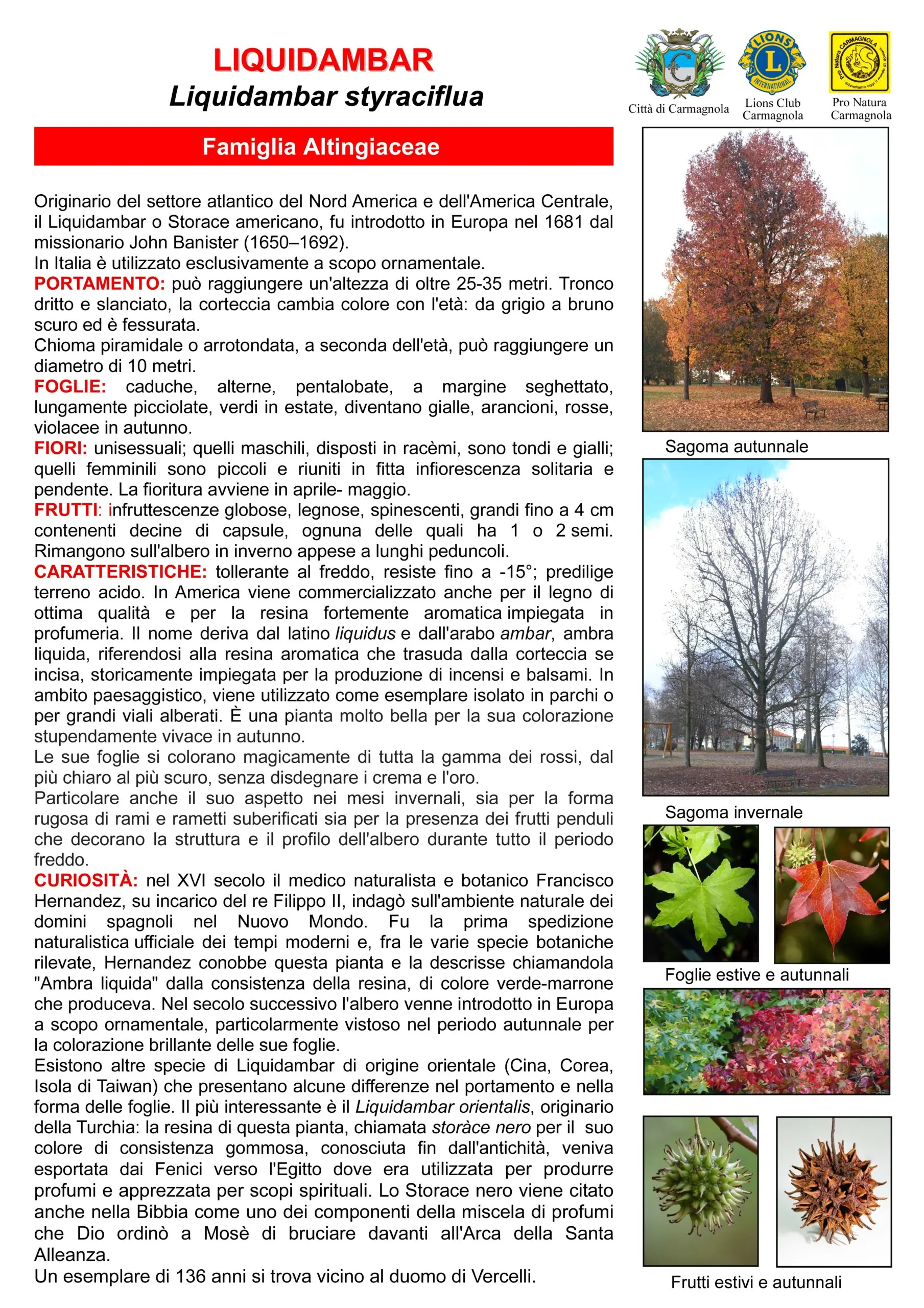
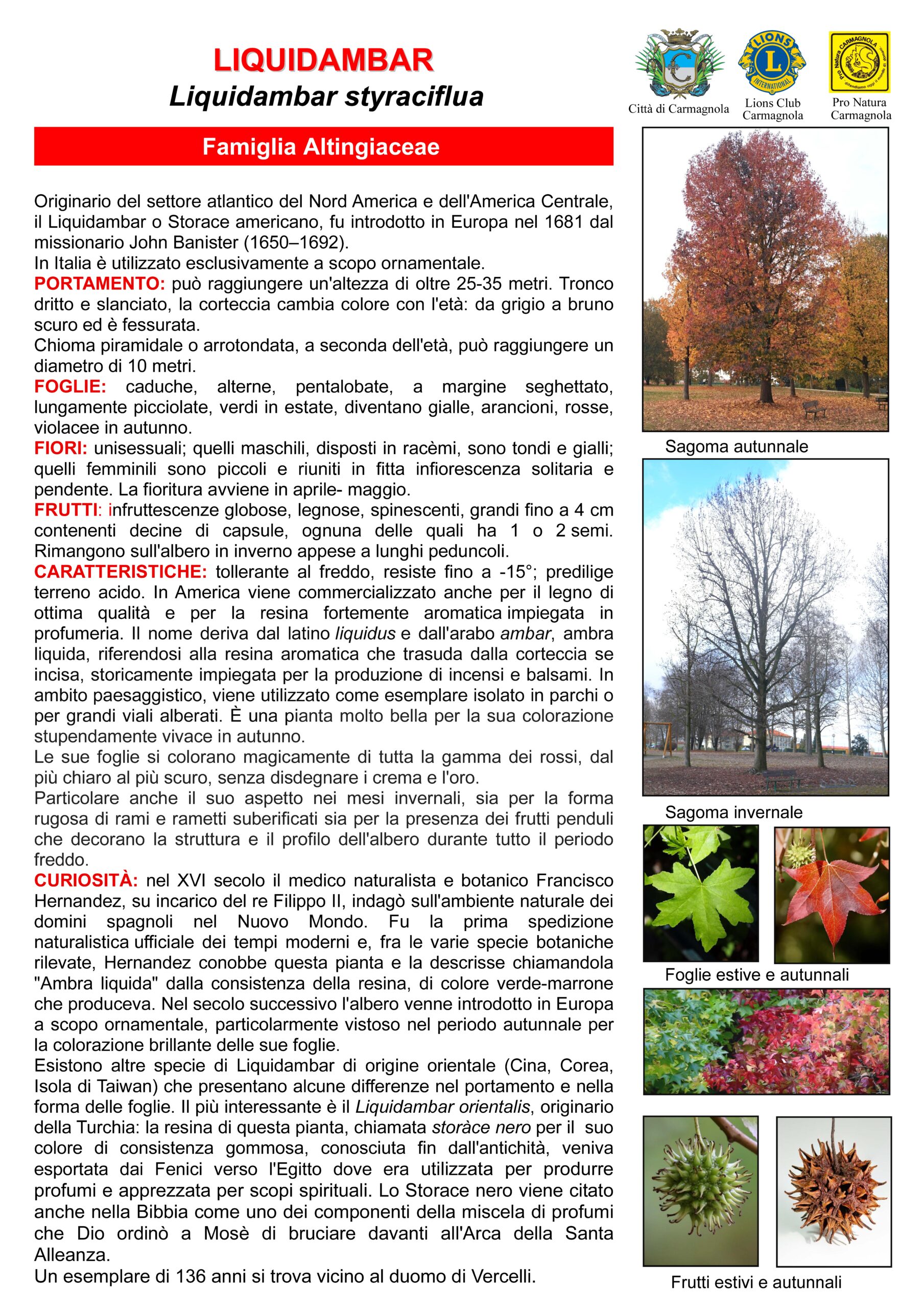
Cold-tolerant, it withstands temperatures down to −15 °C; it prefers acid soil. In America it is also sold commercially for its excellent timber and for its strongly aromatic resin, used in perfumery. The name comes from the Latin liquidus and the Arabic ambar, liquid amber, and refers to the aromatic resin that oozes from the bark when it is cut, historically used to make incense and balms. In landscaping it is used as a specimen tree standing alone in parks or for large tree-lined avenues. It is a very beautiful plant on account of its wonderfully vivid colouring in autumn. Its leaves magically take on the whole range of reds, from the lightest to the darkest, not disdaining creams and gold. Its appearance in the winter months is distinctive too, both for the wrinkled shape of its corky branches and twigs and for the hanging fruits that adorn the framework and outline of the tree throughout the cold season.
- Curiosities
In the 16th century the physician, naturalist and botanist Francisco Hernandez, commissioned by King Philip II, investigated the natural environment of the Spanish dominions in the New World. It was the first official natural history expedition of modern times and, among the various plant species recorded, Hernandez came to know this plant and described it, calling it "liquid amber" after the consistency of the greenish-brown resin it produced. In the following century the tree was introduced into Europe as an ornamental, particularly striking in autumn for the brilliant colouring of its leaves. There are other species of Liquidambar of Eastern origin (China, Korea, the island of Taiwan), which differ somewhat in habit and in the shape of their leaves. The most interesting is Liquidambar orientalis, native to Turkey: the resin of this plant, called storace nero ("black storax") for its colour, gummy in consistency and known since antiquity, was exported by the Phoenicians to Egypt, where it was used to make perfumes and valued for spiritual purposes. Black storax is also mentioned in the Bible as one of the ingredients of the blend of perfumes that God ordered Moses to burn before the Ark of the Holy Covenant. A 136-year-old specimen stands near the cathedral of Vercelli.
The original sheet (in Italian)
Show the illustrated sheet