Cascina Vigna Park · tree 04 of 23
Horse chestnut
Aesculus hippocastanum
A tree native to eastern Europe, introduced into Europe in the 16th century; it grows wild only in the Balkan peninsula.
For children, and not only for them… (video in Italian)
Tree sheet
- Habit
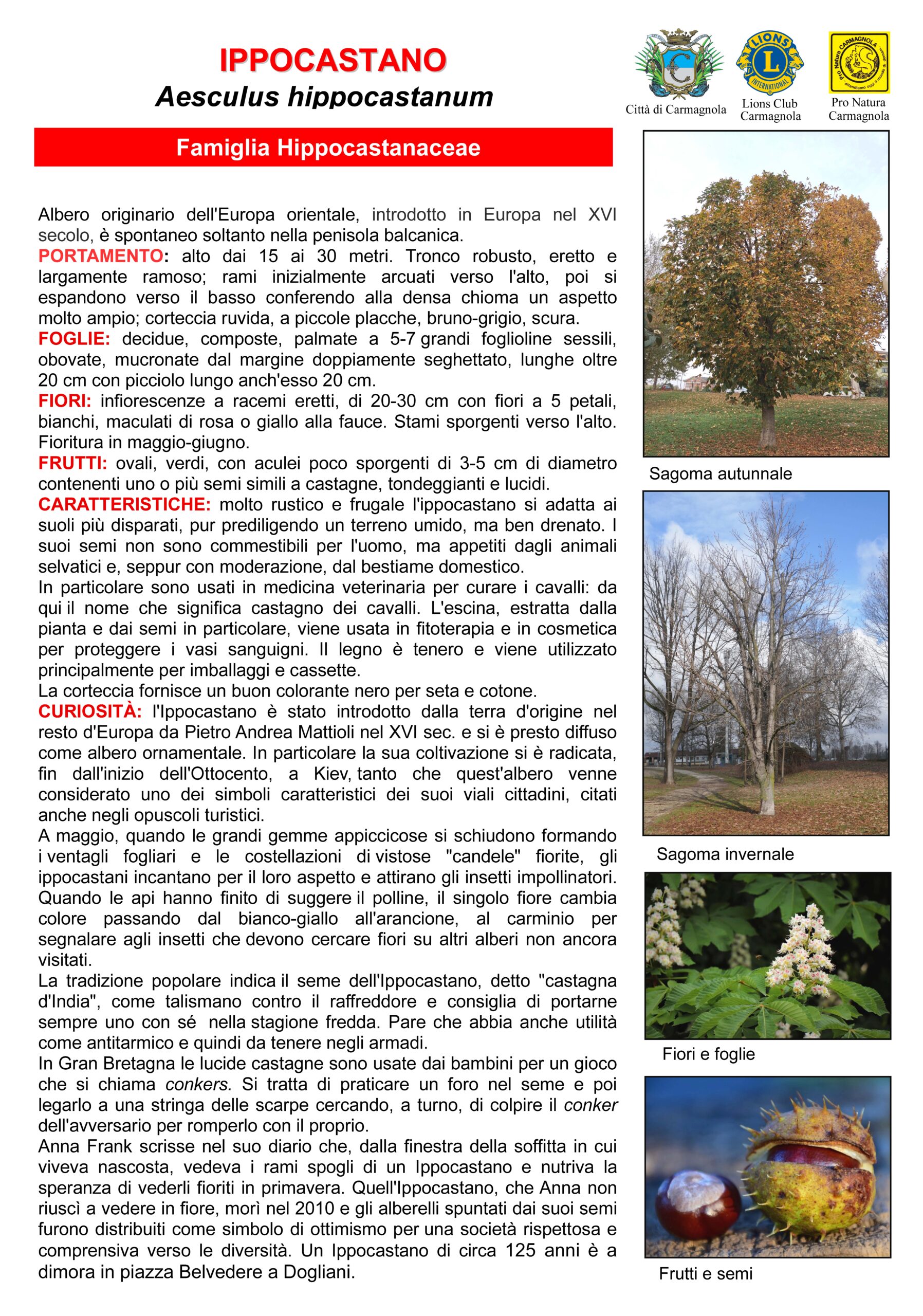
15 to 30 metres tall. Trunk sturdy, upright and widely branching; branches at first arching upwards, then spreading downwards, giving the dense crown a very broad appearance; bark rough, in small plates, dark grey-brown.
- Leaves
Deciduous, compound, palmate with 5–7 large sessile leaflets, obovate, mucronate, with a doubly serrated margin, over 20 cm long, with a leaf stalk that is also 20 cm long.
- Flowers
Inflorescences in upright racemes, 20–30 cm long, with white 5-petalled flowers, blotched with pink or yellow at the throat. Stamens projecting upwards. It flowers in May–June.
- Fruits
Oval, green, with short spines, 3–5 cm in diameter, containing one or more chestnut-like seeds, rounded and glossy.
- Features
Very hardy and undemanding, the horse chestnut adapts to the most varied soils, although it prefers moist but well-drained ground. Its seeds are not edible for humans, but are readily eaten by wild animals and, though in moderation, by farm livestock.
In particular they are used in veterinary medicine to treat horses: hence the name, which means "horses' chestnut". Aescin, extracted from the plant and from the seeds in particular, is used in herbal medicine and in cosmetics to protect the blood vessels. The wood is soft and is used mainly for packaging and crates.
The bark yields a good black dye for silk and cotton.
- Curiosities
The horse chestnut was introduced from its native land to the rest of Europe by Pietro Andrea Mattioli in the 16th century and soon spread as an ornamental tree. In particular its cultivation took root, from the beginning of the 19th century, in Kyiv, so much so that this tree came to be regarded as one of the characteristic symbols of the city's avenues, which are mentioned in tourist brochures too.
In May, when the large sticky buds open to form the fans of leaves and the constellations of showy flowering "candles", horse chestnuts enchant with their appearance and attract pollinating insects. When the bees have finished sucking the pollen, the individual flower changes colour, passing from white-yellow to orange and to carmine, to signal to the insects that they must look for flowers on other trees not yet visited.
Folk tradition holds the seed of the horse chestnut, known in Italian as "castagna d'India" ("Indian chestnut"), to be a talisman against colds, and recommends always carrying one with you in the cold season. It is also said to be useful as a moth repellent, and so to be kept in wardrobes.
In Great Britain the glossy chestnuts are used by children for a game called conkers. It consists in making a hole in the seed and tying it to a shoelace, then trying, in turn, to hit the opponent's conker and break it with one's own.
Anne Frank wrote in her diary that, from the window of the attic where she lived in hiding, she could see the bare branches of a horse chestnut and cherished the hope of seeing them in flower in spring. That horse chestnut, which Anne did not live to see in flower, died in 2010, and the saplings that sprouted from its seeds were distributed as a symbol of optimism for a society that is respectful and understanding of diversity. A horse chestnut about 125 years old grows in piazza Belvedere in Dogliani.
The original sheet (in Italian)
Show the illustrated sheet