Cascina Vigna Park · tree 23 of 23
Deodar cedar
Cedrus deodara
It is a majestic evergreen conifer native to the Himalayan range and the mountains of Afghanistan.
Its specific name, deodara, comes from Sanskrit and means "tree of the gods", a sign of its link with the sacred mountains of the Himalayas. It was introduced into Italy in the 19th century and became popular in parks. (Within the family, the genus Cedrus comprises only the cedars of Lebanon, of the Atlas and of Cyprus.)
For children, and not only for them… (video in Italian)
Tree sheet
- Habit
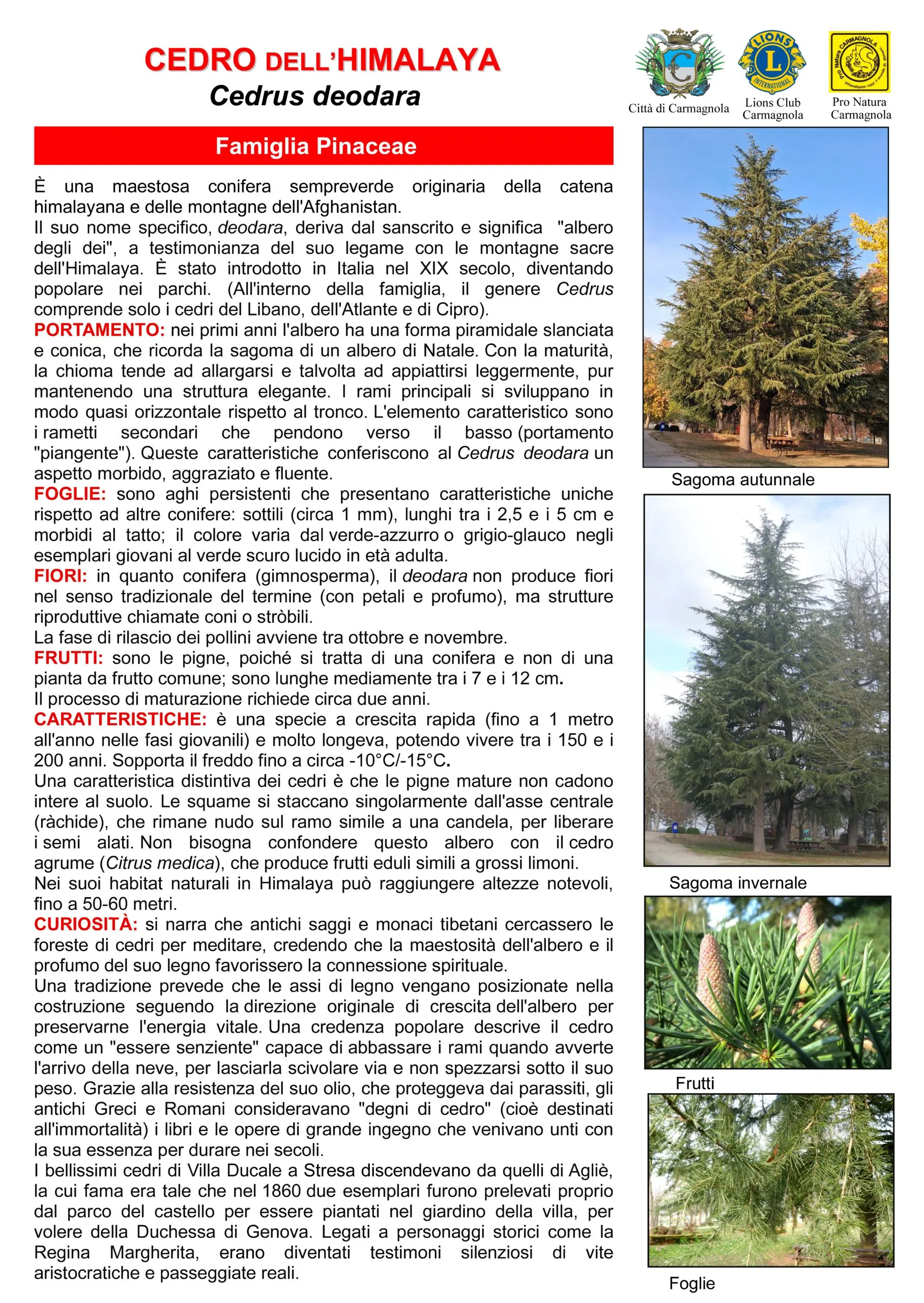
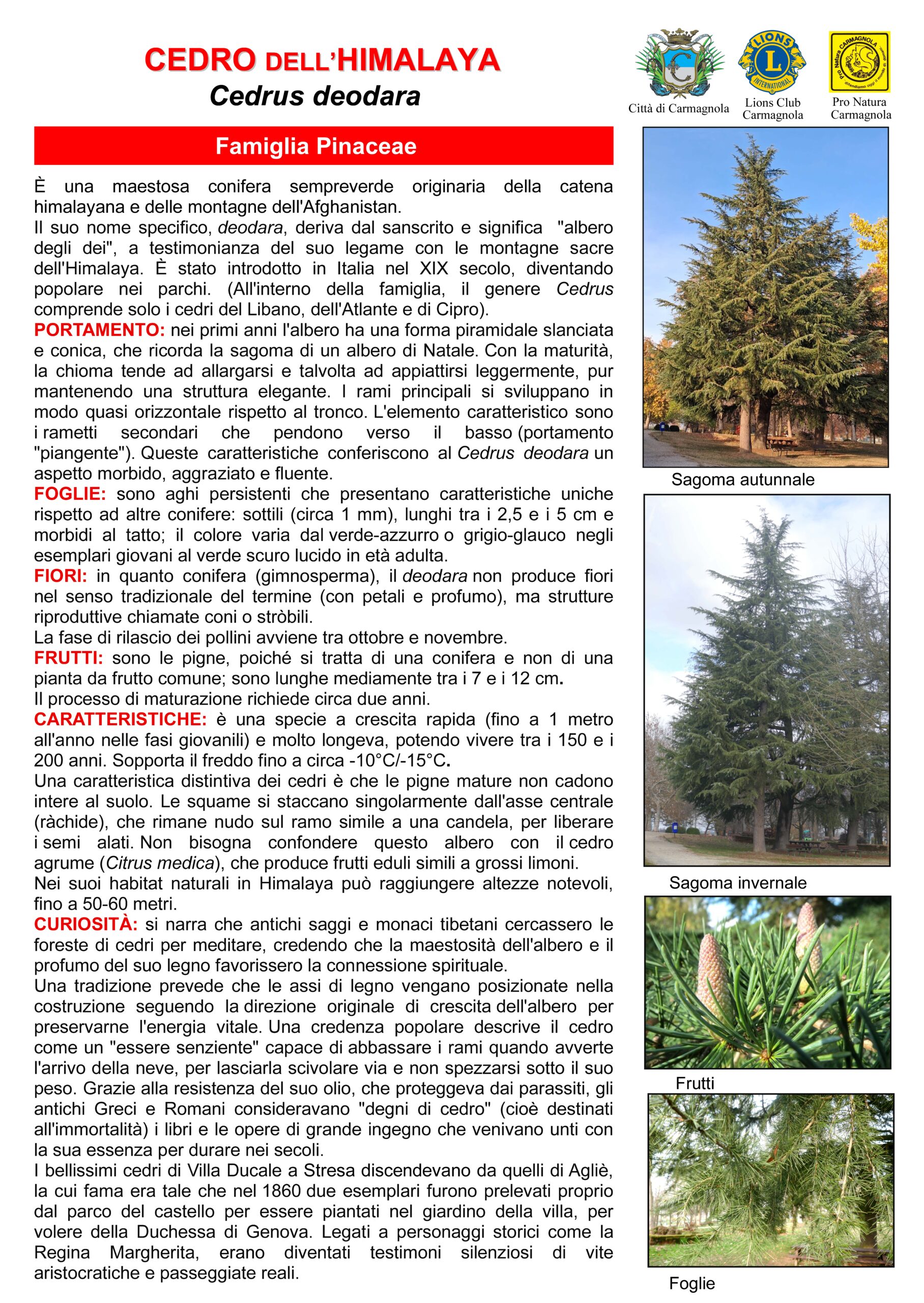
In its early years the tree has a slender, conical pyramidal shape that recalls the silhouette of a Christmas tree. With maturity the crown tends to broaden and sometimes to flatten slightly, while keeping an elegant structure. The main branches grow almost horizontally from the trunk. The characteristic feature is the secondary twigs, which hang downwards ("weeping" habit). These features give Cedrus deodara a soft, graceful, flowing appearance.
- Leaves
They are persistent needles with features that set them apart from those of other conifers: thin (about 1 mm), between 2.5 and 5 cm long and soft to the touch; the colour varies from blue-green or glaucous grey in young trees to glossy dark green in mature ones.
- Flowers
Being a conifer (a gymnosperm), the deodara does not produce flowers in the traditional sense of the word (with petals and scent), but reproductive structures called cones or strobili.
The pollen is released between October and November.
- Fruits
These are the cones, since this is a conifer and not an ordinary fruit-bearing plant; they are on average between 7 and 12 cm long.
Ripening takes about two years.
- Features
It is a fast-growing species (up to 1 metre a year when young) and very long-lived, able to live for between 150 and 200 years. It tolerates cold down to about −10 °C/−15 °C.
A distinctive feature of cedars is that the ripe cones do not fall to the ground whole. The scales come away one by one from the central axis (rachis), which is left bare on the branch like a candle, to release the winged seeds. This tree should not be confused with the citron (Citrus medica), the citrus tree that in Italian is also called cedro, which produces edible fruits like large lemons.
In its natural habitats in the Himalayas it can reach considerable heights, up to 50–60 metres.
- Curiosities
It is said that ancient sages and Tibetan monks sought out cedar forests in which to meditate, believing that the majesty of the tree and the scent of its wood fostered spiritual connection.
According to one tradition, the wooden planks are laid in a building following the tree's original direction of growth, to preserve its vital energy. A popular belief describes the cedar as a "sentient being" able to lower its branches when it senses that snow is coming, to let the snow slide off and avoid breaking under its weight. Thanks to the resistance of its oil, which gave protection against pests, the ancient Greeks and Romans regarded as "worthy of cedar" (that is, destined for immortality) the books and works of great genius that were anointed with its essence so that they would last down the centuries.
The beautiful cedars of Villa Ducale in Stresa were descended from those of Agliè, whose fame was such that in 1860 two specimens were taken from the park of the castle itself to be planted in the garden of the villa, at the wish of the Duchess of Genoa. Linked to historical figures such as Queen Margherita, they had become silent witnesses to aristocratic lives and royal walks.
The original sheet (in Italian)
Show the illustrated sheet