Cascina Vigna Park · tree 18 of 23
Dawn redwood
Metasequoia glyptostroboides
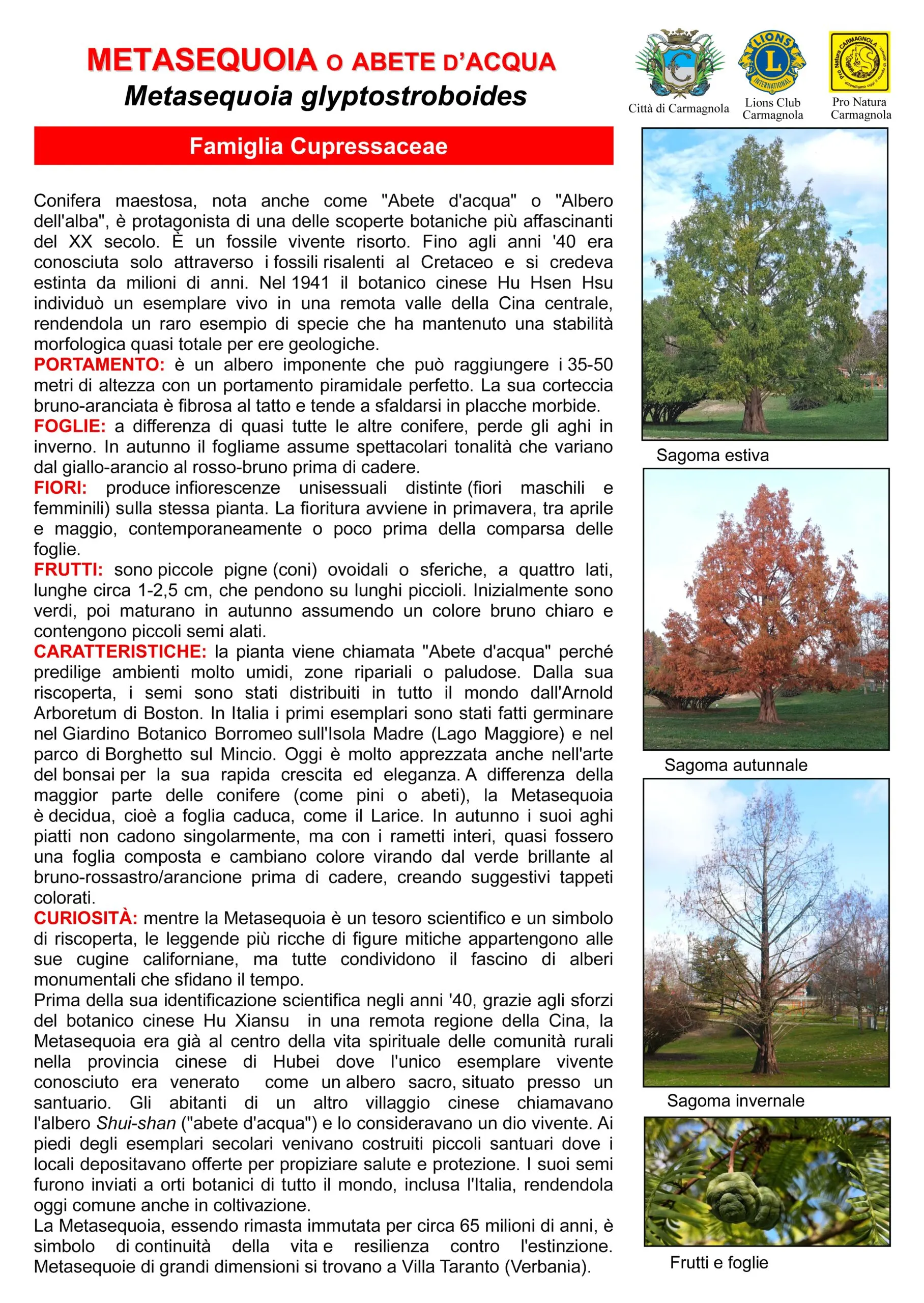
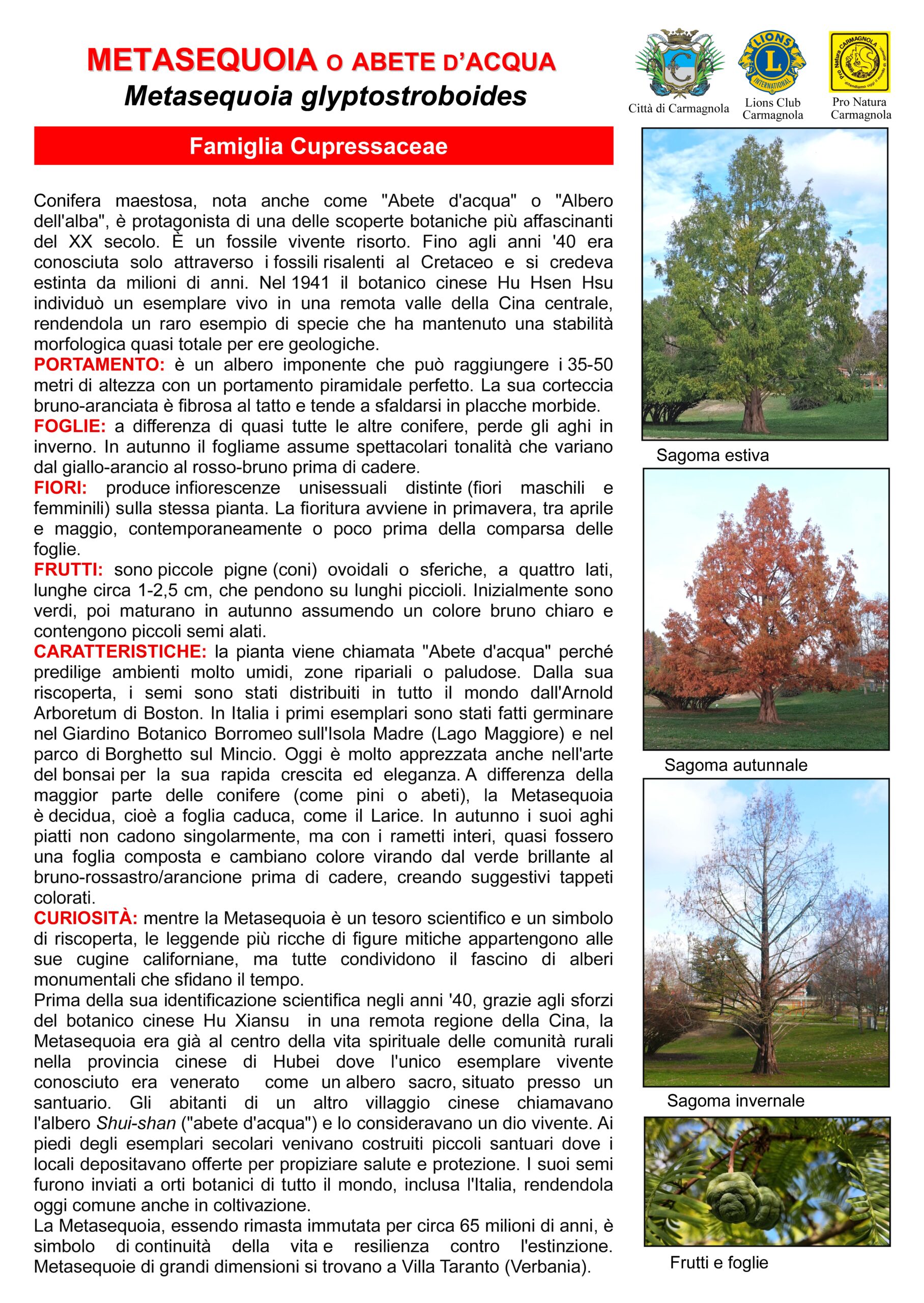
A majestic conifer, also known as the "water fir" or "dawn tree", it is at the centre of one of the most fascinating botanical discoveries of the 20th century. It is a living fossil come back to life. Until the 1940s it was known only from fossils dating back to the Cretaceous and was believed to have been extinct for millions of years. In 1941 the Chinese botanist Hu Hsen Hsu identified a living specimen in a remote valley in central China, making it a rare example of a species that has remained almost entirely unchanged in form over geological eras.
For children, and not only for them… (video in Italian)
Tree sheet
- Habit
It is an imposing tree that can reach 35–50 metres in height, with a perfect pyramidal habit. Its orange-brown bark is fibrous to the touch and tends to flake off in soft plates.
- Leaves
Unlike almost all other conifers, it loses its needles in winter. In autumn the foliage takes on spectacular shades ranging from yellow-orange to red-brown before it falls.
- Flowers
It produces separate unisexual inflorescences (male and female flowers) on the same plant. Flowering takes place in spring, between April and May, at the same time as the leaves appear or shortly before.
- Fruits
They are small ovoid or spherical cones, four-sided, about 1–2.5 cm long, hanging on long stalks. They are green at first, then ripen in autumn, turning light brown, and contain small winged seeds.
- Features
The tree is called the "water fir" because it prefers very damp environments, riverside or marshy areas. Since its rediscovery, the seeds have been distributed all over the world by the Arnold Arboretum in Boston. In Italy the first specimens were germinated in the Borromeo Botanical Garden on Isola Madre (Lake Maggiore) and in the park of Borghetto sul Mincio. Today it is also highly valued in the art of bonsai for its rapid growth and elegance. Unlike most conifers (such as pines or firs), the dawn redwood is deciduous, that is, it sheds its leaves, like the larch. In autumn its flat needles do not fall one by one but together with the whole twigs, almost as if these were compound leaves, and they change colour, turning from bright green to reddish brown/orange before they fall, creating striking carpets of colour.
- Curiosities
While the dawn redwood is a scientific treasure and a symbol of rediscovery, the legends richest in mythical figures belong to its Californian cousins, but all of them share the fascination of monumental trees that defy time. Before its scientific identification in the 1940s, thanks to the efforts of the Chinese botanist Hu Xiansu in a remote region of China, the dawn redwood was already at the centre of the spiritual life of the rural communities in the Chinese province of Hubei, where the only known living specimen, which stood beside a shrine, was venerated as a sacred tree. The inhabitants of another Chinese village called the tree Shui-shan ("water fir") and regarded it as a living god. At the foot of the centuries-old specimens small shrines were built, where local people left offerings to ask for health and protection. Its seeds were sent to botanical gardens all over the world, including Italy, so that today it is common in cultivation too. The dawn redwood, having remained unchanged for about 65 million years, is a symbol of the continuity of life and of resilience against extinction. Large dawn redwoods can be seen at Villa Taranto (Verbania).
The original sheet (in Italian)
Show the illustrated sheet