Cascina Vigna Park · tree 19 of 23
Common yew
Taxus baccata
Also known as the "tree of death", it is an evergreen conifer and one of the longest-lived in Europe, able to live for more than 2,000 years. Very slow-growing, it is found from northern Europe to North Africa and the Caucasus; it is regarded as the most poisonous plant in Italy.
For children, and not only for them… (video in Italian)
Tree sheet
- Habit
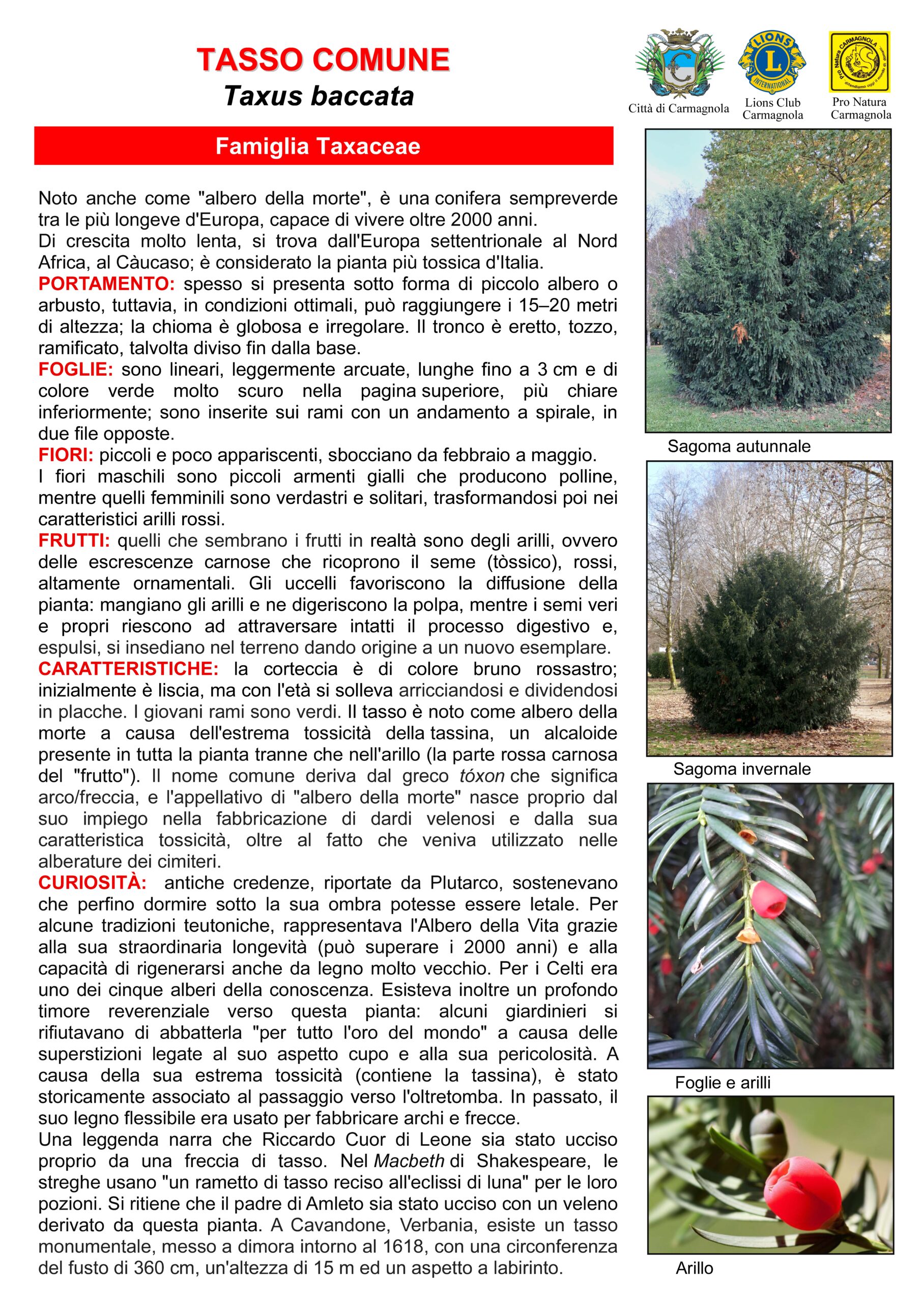
It often takes the form of a small tree or shrub; in ideal conditions, however, it can reach 15–20 metres in height; the crown is rounded and irregular. The trunk is upright, squat and branched, sometimes divided from the base.
- Leaves
They are linear, slightly curved, up to 3 cm long and very dark green on the upper surface, paler beneath; they are set on the branches in a spiral, in two opposite rows.
- Flowers
Small and inconspicuous, they open from February to May. The male flowers are small yellow catkins that produce pollen, while the female ones are greenish and solitary, and later turn into the characteristic red arils.
- Fruits
What look like fruits are in fact arils, that is, fleshy outgrowths that cover the (poisonous) seed; they are red and highly ornamental. Birds help the plant to spread: they eat the arils and digest the pulp, while the seeds themselves pass through the digestive process intact and, once expelled, settle in the soil and give rise to a new plant.
- Features
The bark is reddish brown; at first it is smooth, but with age it lifts, curling and splitting into plates. The young branches are green. The yew is known as the tree of death because of the extreme toxicity of taxine, an alkaloid present throughout the plant except in the aril (the red fleshy part of the "fruit"). The common name (tasso in Italian) derives from the Greek tóxon, meaning bow/arrow, and the epithet "tree of death" comes precisely from its use in making poisoned darts and from its characteristic toxicity, as well as from the fact that it was planted in cemeteries.
- Curiosities
Ancient beliefs, reported by Plutarch, held that even sleeping in its shade could be fatal. In some Teutonic traditions it represented the Tree of Life, thanks to its extraordinary longevity (it can exceed 2,000 years) and its ability to regenerate even from very old wood. For the Celts it was one of the five trees of knowledge. There was also a deep reverential fear of this plant: some gardeners refused to fell it "for all the gold in the world" because of the superstitions attached to its gloomy appearance and to the danger it posed. Because of its extreme toxicity (it contains taxine), it has historically been associated with the passage to the afterlife. In the past its flexible wood was used to make bows and arrows. A legend has it that Richard the Lionheart was killed by a yew arrow. In Shakespeare's Macbeth, the witches use "slips of yew sliver'd in the moon's eclipse" for their potions. It is believed that Hamlet's father was killed with a poison derived from this plant. At Cavandone, Verbania, there is a monumental yew, planted around 1618, with a trunk circumference of 360 cm, a height of 15 m and a labyrinth-like appearance.
The original sheet (in Italian)
Show the illustrated sheet